

Jan-2024 Microsoft MB-800 Certification Real 2024 Mock Exam
MB-800 Exam Questions and Valid PMP Dumps PDF
NEW QUESTION # 58
A company uses Dynamics 365 Business Central.
The company's funds are limited and some invoices that are due cannot be paid on time.
You need to prioritize vendors when you suggest vendor payments.
Which three actions should you perform in sequence? To answer, move the appropriate actions from the list of actions to the answer area and arrange them in the correct order.
Answer:
Explanation:
1 - Set Vendor Priority on the Vendor card....
2 - Enter Available Amount (LCY)....
3 - Select Use Vendor Priority .....
Reference:
https://docs.microsoft.com/en-us/learn/modules/suggest-vendor-payments-dynamics-365-business-central/2-priority
NEW QUESTION # 59
You are setting up a new item in Dynamics 365 Business Central. The item is a tangible good with an inventory asset value. The item is acquired by purchase specifically for each new instance of demand from an order.
You need to configure the Type, Replenishment System, and Reordering Policy fields on the item card to achieve the stated requirements.
How should you configure each field? To answer, drag the appropriate values to the correct fields. Each value may be used once, more than once, or not at all. You may need to drag the split bar between panes or scroll to view content.
NOTE: Each correct selection is worth one point.
Answer:
Explanation:
Reference:
https://usedynamics.com/business-central/product-dev/replenishment-system/
https://usedynamics.com/business-central/product-dev/reordering-policy/
NEW QUESTION # 60
You need to configure discounting for sales.
Which three actions should you perform in sequence? To answer, move the appropriate actions from the list of actions to the answer area.
Answer:
Explanation:
1 - CONFIGURE Discount Posting in Sales & Receivable Setup
2 - Create a Customer Discount Group
3 - Define the Sales Line Discounts
NEW QUESTION # 61
You are setting up approval workflows in Dynamics 365 Business Central.
You need to configure approval limits.
Which approver limit types should you use? To answer, drag the appropriate approver limit types to the correct requirements. Each approver limit type may be used once, or not at all. You may need to drag the split bar between panes or scroll to view content.
NOTE: Each correct selection is worth one point.
Answer:
Explanation:
Reference:
https://ebs.com.au/blog/how-approver-limit-type-works-for-purchase-order-workflows-in-microsoft-dynamics-365
NEW QUESTION # 62
Note: This question is part of a series of questions that present the same scenario. Each question in the series contains a unique solution that might meet the stated goals. Some question sets might have more than one correct solution, while others might not have a correct solution.
After you answer a question in this section, you will NOT be able to return to it. As a result, these questions will not appear in the review screen.
You are implementing Dynamics 365 Business Central for a company. The company provides subscription services to their customers. The subscription invoices are almost identical each month.
The company wants to set up recurring sales lines for subscription invoices.
You need to create systems for creating subscription invoices.
Solution: Create a new recurring sales line. Open the relevant customers and attach the Recurring Sales Lines code to the customer. Then, run the Create Recurring Sales Invoices batch to create the invoices.
Does the solution meet the goal?
- A. No
- B. Yes
Answer: B
Explanation:
Reference:
https://docs.microsoft.com/en-gb/dynamics365/business-central/sales-how-work-standard-lines
Topic 2, Case Study A Cash and carry
This is a case study. Case studies are not timed separately. You can use as much exam time as you would like to complete each case. However, there may be additional case studies and sections on this exam. You must manage your time to ensure that you are able to complete all questions included on this exam in the time provided.
To answer the questions included in a case study, you will need to reference information that is provided in the case study. Case studies might contain exhibits and other resources that provide more information about the scenario that is described in the case study. Each question is independent of the other questions in this case study.
At the end of this case study, a review screen will appear. This screen allows you to review your answers and to make changes before you move to the next section of the exam. After you begin a new section, you cannot return to this section.
To start the case study
To display the first question in the case study, click the button. Use the buttons in the left pane to explore the content of the case study before you answer the questions. Clicking these buttons displays information such as business requirements, existing environment, and problem statements. When you are ready to answer a question, click the Question button to return to the question.
Current environment
Cash and carry sales
* When a customer makes a purchase at the company's cash and carry desk, the sale is handwritten on a three-part form.
* The cash and carry associate retrieves the items listed on the order from the warehouse.
* Special prices and discounts are used to move products that will expire soon or that are overstocked.
* Cash is accepted for payments.
* The cash drawer is balanced at the end of every day. A deposit is created for the cash and given to the accountant.
Brokered sales orders
* Brokered sales are called in to customer service by the brokers and sometimes directly by customers.
The sales are entered into QuickBooks.
* Because inventory is not tracked in QuickBooks, the generic item Brokered Item is used.
* Two copies of the packing slip and printed from QuickBooks and sent to the warehouse.
Order picking
* The warehouse manager provides a container and the two copies of the packing slip to a picker.
* Items that are out of stock are marked on both copies of the packing slip.
* The shipping amount is determined and written on the packing slips.
* One copy of the completed packing slip is placed in a basket for customer service.
* Completed orders are boxed up with a copy of the invoice and shipped to customers.
Order invoicing
* Throughout the day, the customer service manager collects the packing slip copies and updates the invoices in QuickBooks.
* The customer service manager adds a line for shipping with the amount provided by the packer.
* The customer service manager prints a copy of the final invoice and sends it to the warehouse.
* The accountant uses Microsoft Word to create weekly invoices for all shipments invoiced in QuickBooks during the week for some customers.
Cash and carry sales
* One-line sales invoices are saved in QuickBooks for each cash and carry sale to a miscellaneous customer.
* Customer details for cash and carry sales are not kept in QuickBooks.
Deposits
* The accountant receives the deposit bag from the cash and carry sales desk at the end of every day.
* Receipts are recorded in QuickBooks against cash and carry and brokered sales based on the deposit slips.
Brokers commission
* Brokers fees are paid as a percentage of sales.
* A Sales by Product/Service Summary report is run in QuickBooks every month for Brokered Item to calculate what is owned.
Requirements
Customers
* Users with permission must be able to quickly add new customers.
* The original source of all customers in the accounting system must be identified to be from cash and carry or brokered sales.
* The company needs to keep a record of special price promotions given to specific customers.
* Customers must be identified with a unique general business posting group so that the correct freight G/L account is used in sales transactions.
Sales
* The customer source must be used to identify the business line, and the customer source must be indicated on every sales transactions.
* Customer service and cash and carry desk associates must be able to enter sales into Dynamics 365 Business Central by customer.
* Excess paper must be eliminated, and paper management must be reduced.
* If a customer is not already listed in the system, a cash and carry associate or customer service associate must be able to quickly add the new customer in the process of recording the first sale.
* A point-of-sale system is not needed, but users must be able to record which items are purchased by customers, accept and record their payment, and print receipts indicating paid in full.
Items
* The sales manager and warehouse manager must be able to set a specific timeframe for special promotion discounts on items.
* For special promotions, discounts must be consistent for all items in a product line using a single discount calculation.
* Special pricing may be given to a retail chain or buying group. This pricing must be automatically applied when an order is taken for any of these customers. The original price must be recorded with each sale.
* Customers must always be charged the lowest amount for an item at the time of the sale. For example, an overstocked olive oil has a regular price of $20 per unit. Customers in a buying group for restaurants can buy it for $18 per unit. There is an autumn promotion price for the item at $19 per unit. However, on a specific day only, there is an overstock special at a 15 percent discount off the regular price.
Sales invoices
* Warehouse workers must be able to indicate the following in the system for each order:
1. the items picked
2. the shipping charges
3. notifications, if any, that customer service needs to provide to the customer
* Items sold at a discount must show the original price, discount, and net amount on each line of the invoice. Invoices must be posted at the cash and carry desk at the time of sale. For orders, accounting must post invoices and send them to customers.
* Warehouse employees must be able to indicate what has been shipped on an order. They will use the G/L account for shipping charges. They need to use the correct G/L account for sales versus cost through proper assignment of sales and purchase accounts in the general posting setup.
* Some of the brokered customers require one invoice per week regardless of the number of orders or shipments.
Accounts
* Payment terms vary by customer.
* The amount paid to brokers must be calculated from sales after invoice discounts.
* Broker vendors must be easily identifiable from other vendors in lists
* Commission paid on sales not collected within 120 days must be deducted from brokers' next compensation payment.
Reporting
Wide World Importers requires reporting on the following:
* the overall profitability of each line of business at any time for any given period
* the cost of outbound shipping in the overall profitability of sales by business line in all related reports
* freight sales and cost by account in the trial balance
* the cost of brokers' compensation in reporting the overall profitability of sales by business line
* the effect of item discount promotions in financial statements.
Issues
Pricing
* Spreadsheets are used to maintain special item pricing and discounts. The only source of product line discount information is a whiteboard in the warehouse. The price charged is frequently incorrect.
* Customers complain when they think they think they have not received the best price available.
Promotions are sometimes applied in error after a special pricing event ends, for example, when discounts are offered temporarily to reduce overstock.
* Management cannot see original versus actual price on all sales. Discounts given by brokers requires spreadsheets and comparison between price list and price on sales invoice. Management needs to be able to quickly see the discount given on each sale.
Payment terms
* Agreed-upon payment terms are frequently entered incorrectly on orders, causing cashflow issues.
Invoices already paid in full exist on the sales aging reports. The frequent cause of this issue is that sales from the cash and carry desk are not indicated as cash sales and are not posted as paid in full.
Some buying groups require that all invoices sent during a month be due on the 20th of the following month.
Invoicing
* Paperwork is frequently misplaced between the warehouse, customer service, and accounting.
* Invoices that are posted in the accounting system based on shipments and invoices that are sent to customers weekly do not match due to errors transferring the data from one document to another.
* Users are selecting the incorrect freight type (expense versus sales) on purchase and sales transactions, making it difficult to reconcile freight costs.
* Sales placed from the cash and carry desk by customers originally acquired through a broker are not being recognized with the correct customer source. Reporting by business line is inaccurate.
Accounts
* Users often forget which fields to use to enter information when they add new customers to QuickBooks. This results in errors and inconsistencies in data and affects sales reporting. Confidence in sales reporting accuracy is low.
* Adding new brokers is a different process than adding other purchase vendors. Users often forget which fields to select and how to correctly assign the vendor number to add new brokers.
* Manual entries to certain G/L accounts cause reconciliation issues.
NEW QUESTION # 63
You are implementing Dynamics 365 Business Central Online.
You receive a comprehensive price list from the customer. The customer wants you to set up the best price feature for sales by using the standard discount and pricing functionality in Business Central.
You need to set up this feature.
Which three components are part of the best price calculation feature? Each correct answer presents a complete solution.
NOTE: Each correct selection is worth one point.
- A. Unit cost on items
- B. Unit prices on items
- C. Discount Groups
- D. Special Prices
- E. Sales Line Discounts
Answer: C,D,E
Explanation:
https://docs.microsoft.com/en-us/dynamics365/business-central/sales-how-record-sales-price-discount-payment-agreements?tabs=current-experience.
NEW QUESTION # 64
You need to ensure that any transaction that uses a customer account always includes the customer source dimension.
Which five actions should you perform in sequence? To answer, move the appropriate actions from the list of actions to the answer area and arrange them in the correct order.
Answer:
Explanation:
1 - Create dimension values for the customer source dimension code.
2 - Select the Search icon, enter Chart of Accounts, and then select the related link,
3 - From the Dimension code, select the Account Type Default Dimension list.
4 - Select the Dimension Value code that is used for the customer source.
5 - Set the Value Posting to Code Mandatory
Reference:
https://stoneridgesoftware.com/how-to-set-up-required-dimensions-in-dynamics-365-business-edition/
NEW QUESTION # 65
You need to undo an incorrectly posted purchase receipt from a related purchase order.
Which four actions should you perform in sequence? To answer, move the appropriate actions from the list of actions to the answer area and arrange them in the correct order.
Answer:
Explanation:
Reference:
https://bondconsultingservices.com/2018/09/06/microsoft-dynamics-365-business-central-purchase-order-receipt-reversal/
https://docs.microsoft.com/en-gb/dynamics365/business-central/finance-how-reverse-journal-posting
NEW QUESTION # 66
You set up a new company for a customer. The customer provides you with the chart of accounts and the preferred grouping of items, vendors, and customers.
You must ensure that item posting corresponds with the grouping preferences and chart of accounts for the customer.
You need to create the posting groups and setup.
Which type of posting groups should you create? To answer, drag the appropriate posting group types to the correct entities. Each posting group type may be used once, more than once, or not at all. You may need to drag the split bar between panes or scroll to view content.
NOTE: Each correct selection is worth one point.
Answer:
Explanation:
Reference:
https://docs.microsoft.com/en-gb/dynamics365/business-central/finance-posting-groups
NEW QUESTION # 67
You are setting up a new item in Dynamics 365 Business Central. The item is a tangible good with an inventory asset value. The item is acquired by purchase specifically for each new instance of demand from an order.
You need to configure the Type, Replenishment System, and Reordering Policy fields on the item card to achieve the stated requirements.
How should you configure each field? To answer, drag the appropriate values to the correct fields. Each value may be used once, more than once, or not at all. You may need to drag the split bar between panes or scroll to view content.
NOTE: Each correct selection is worth one point.
Answer:
Explanation:
Reference:
https://usedynamics.com/business-central/product-dev/replenishment-system/
https://usedynamics.com/business-central/product-dev/reordering-policy/
NEW QUESTION # 68
You are implementing Dynamics 365 Business Central. The accounting manager of the company provides you with the chart of accounts.
You need to set up specific posting groups according to the chart of accounts.
Which setup should you use? To answer, drag the appropriate setup to the correct action. Each setup may be used once, more than once, or not at all. You may need to drag the split bar between panes or scroll to view content.
NOTE: Each correct selection is worth one point.
Answer:
Explanation:
Explanation
Reference:
https://docs.microsoft.com/en-us/learn/modules/posting-groups-dynamics-365-business-central/1-set-up
Topic 2, Case Study A Cash and carry
This is a case study. Case studies are not timed separately. You can use as much exam time as you would like to complete each case. However, there may be additional case studies and sections on this exam. You must manage your time to ensure that you are able to complete all questions included on this exam in the time provided.
To answer the questions included in a case study, you will need to reference information that is provided in the case study. Case studies might contain exhibits and other resources that provide more information about the scenario that is described in the case study. Each question is independent of the other questions in this case study.
At the end of this case study, a review screen will appear. This screen allows you to review your answers and to make changes before you move to the next section of the exam. After you begin a new section, you cannot return to this section.
To start the case study
To display the first question in the case study, click the button. Use the buttons in the left pane to explore the content of the case study before you answer the questions. Clicking these buttons displays information such as business requirements, existing environment, and problem statements. When you are ready to answer a question, click the Question button to return to the question.
Current environment
Cash and carry sales
* When a customer makes a purchase at the company's cash and carry desk, the sale is handwritten on a three-part form.
* The cash and carry associate retrieves the items listed on the order from the warehouse.
* Special prices and discounts are used to move products that will expire soon or that are overstocked.
* Cash is accepted for payments.
* The cash drawer is balanced at the end of every day. A deposit is created for the cash and given to the accountant.
Brokered sales orders
* Brokered sales are called in to customer service by the brokers and sometimes directly by customers.
The sales are entered into QuickBooks.
* Because inventory is not tracked in QuickBooks, the generic item Brokered Item is used.
* Two copies of the packing slip and printed from QuickBooks and sent to the warehouse.
Order picking
* The warehouse manager provides a container and the two copies of the packing slip to a picker.
* Items that are out of stock are marked on both copies of the packing slip.
* The shipping amount is determined and written on the packing slips.
* One copy of the completed packing slip is placed in a basket for customer service.
* Completed orders are boxed up with a copy of the invoice and shipped to customers.
Order invoicing
* Throughout the day, the customer service manager collects the packing slip copies and updates the invoices in QuickBooks.
* The customer service manager adds a line for shipping with the amount provided by the packer.
* The customer service manager prints a copy of the final invoice and sends it to the warehouse.
* The accountant uses Microsoft Word to create weekly invoices for all shipments invoiced in QuickBooks during the week for some customers.
Cash and carry sales
* One-line sales invoices are saved in QuickBooks for each cash and carry sale to a miscellaneous customer.
* Customer details for cash and carry sales are not kept in QuickBooks.
Deposits
* The accountant receives the deposit bag from the cash and carry sales desk at the end of every day.
* Receipts are recorded in QuickBooks against cash and carry and brokered sales based on the deposit slips.
Brokers commission
* Brokers fees are paid as a percentage of sales.
* A Sales by Product/Service Summary report is run in QuickBooks every month for Brokered Item to calculate what is owned.
Requirements
Customers
* Users with permission must be able to quickly add new customers.
* The original source of all customers in the accounting system must be identified to be from cash and carry or brokered sales.
* The company needs to keep a record of special price promotions given to specific customers.
* Customers must be identified with a unique general business posting group so that the correct freight G/L account is used in sales transactions.
Sales
* The customer source must be used to identify the business line, and the customer source must be indicated on every sales transactions.
* Customer service and cash and carry desk associates must be able to enter sales into Dynamics 365 Business Central by customer.
* Excess paper must be eliminated, and paper management must be reduced.
* If a customer is not already listed in the system, a cash and carry associate or customer service associate must be able to quickly add the new customer in the process of recording the first sale.
* A point-of-sale system is not needed, but users must be able to record which items are purchased by customers, accept and record their payment, and print receipts indicating paid in full.
Items
* The sales manager and warehouse manager must be able to set a specific timeframe for special promotion discounts on items.
* For special promotions, discounts must be consistent for all items in a product line using a single discount calculation.
* Special pricing may be given to a retail chain or buying group. This pricing must be automatically applied when an order is taken for any of these customers. The original price must be recorded with each sale.
* Customers must always be charged the lowest amount for an item at the time of the sale. For example, an overstocked olive oil has a regular price of $20 per unit. Customers in a buying group for restaurants can buy it for $18 per unit. There is an autumn promotion price for the item at $19 per unit. However, on a specific day only, there is an overstock special at a 15 percent discount off the regular price.
Sales invoices
* Warehouse workers must be able to indicate the following in the system for each order:
1. the items picked
2. the shipping charges
3. notifications, if any, that customer service needs to provide to the customer
* Items sold at a discount must show the original price, discount, and net amount on each line of the invoice. Invoices must be posted at the cash and carry desk at the time of sale. For orders, accounting must post invoices and send them to customers.
* Warehouse employees must be able to indicate what has been shipped on an order. They will use the G/L account for shipping charges. They need to use the correct G/L account for sales versus cost through proper assignment of sales and purchase accounts in the general posting setup.
* Some of the brokered customers require one invoice per week regardless of the number of orders or shipments.
Accounts
* Payment terms vary by customer.
* The amount paid to brokers must be calculated from sales after invoice discounts.
* Broker vendors must be easily identifiable from other vendors in lists
* Commission paid on sales not collected within 120 days must be deducted from brokers' next compensation payment.
Reporting
Wide World Importers requires reporting on the following:
* the overall profitability of each line of business at any time for any given period
* the cost of outbound shipping in the overall profitability of sales by business line in all related reports
* freight sales and cost by account in the trial balance
* the cost of brokers' compensation in reporting the overall profitability of sales by business line
* the effect of item discount promotions in financial statements.
Issues
Pricing
* Spreadsheets are used to maintain special item pricing and discounts. The only source of product line discount information is a whiteboard in the warehouse. The price charged is frequently incorrect.
* Customers complain when they think they think they have not received the best price available.
Promotions are sometimes applied in error after a special pricing event ends, for example, when discounts are offered temporarily to reduce overstock.
* Management cannot see original versus actual price on all sales. Discounts given by brokers requires spreadsheets and comparison between price list and price on sales invoice. Management needs to be able to quickly see the discount given on each sale.
Payment terms
* Agreed-upon payment terms are frequently entered incorrectly on orders, causing cashflow issues.
Invoices already paid in full exist on the sales aging reports. The frequent cause of this issue is that sales from the cash and carry desk are not indicated as cash sales and are not posted as paid in full.
Some buying groups require that all invoices sent during a month be due on the 20th of the following month.
Invoicing
* Paperwork is frequently misplaced between the warehouse, customer service, and accounting.
* Invoices that are posted in the accounting system based on shipments and invoices that are sent to customers weekly do not match due to errors transferring the data from one document to another.
* Users are selecting the incorrect freight type (expense versus sales) on purchase and sales transactions, making it difficult to reconcile freight costs.
* Sales placed from the cash and carry desk by customers originally acquired through a broker are not being recognized with the correct customer source. Reporting by business line is inaccurate.
Accounts
* Users often forget which fields to use to enter information when they add new customers to QuickBooks. This results in errors and inconsistencies in data and affects sales reporting. Confidence in sales reporting accuracy is low.
* Adding new brokers is a different process than adding other purchase vendors. Users often forget which fields to select and how to correctly assign the vendor number to add new brokers.
* Manual entries to certain G/L accounts cause reconciliation issues.
NEW QUESTION # 69
You need to configure the system to show the sales discounts.
How should you configure the system? To answer, select the appropriate options in the answer area.
NOTE: Each correct selection is worth one point.
Answer:
Explanation:
Explanation
NEW QUESTION # 70
A furniture manufacturing company is creating new items in Dynamics 365 Business Central. The company currently searches for the products by material, color, and size.
You must expand the search capabilities for the items. Not all the items will have the same searchable characteristics. Some new search characteristics may need to be added.
You need to configure the system to automatically recommend additional search criteria for items.
Which features should you use? To answer, select the appropriate options in the answer area.
NOTE: Each correct selection is worth one point.
Answer:
Explanation:
Reference:
https://docs.microsoft.com/en-gb/dynamics365/business-central/inventory-how-work-item-attributes
NEW QUESTION # 71
A company uses Dynamics 365 Business Central.
The company wants to automate sales credit memo processing.
You need to configure the system to meet the requirements.
What should you do? To answer, select the appropriate options in the answer area.
NOTE: Each correct selection is worth one point.
Answer:
Explanation:
NEW QUESTION # 72
You need to report profitability by business line.
How should you configure the system? To answer, select the appropriate options in the answer area.
NOTE: Each correct selection is worth one point.
Answer:
Explanation:
Explanation
NEW QUESTION # 73
A company uses Dynamics 365 Business Central.
The company's funds are limited and some invoices that are due cannot be paid on time.
You need to prioritize vendors when you suggest vendor payments.
Which three actions should you perform in sequence? To answer, move the appropriate actions from the list of actions to the answer area and arrange them in the correct order.
Answer:
Explanation:
1 - Set Vendor Priority on the Vendor card using the lowest number, expect zero, for the highest priority.
2 - Enter Available Amount (LCY) when you run the Suggest Vendor Payment batch job.
3 - Select Use Vendor Priority when you run the Suggest Vendor Payments batch job.
Reference:
https://docs.microsoft.com/en-us/learn/modules/suggest-vendor-payments-dynamics-365-business-central/2-priority
NEW QUESTION # 74
You are setting up approval workflows in Dynamics 365 Business Central.
You need to configure approval limits.
Which approver limit types should you use? To answer, drag the appropriate approver limit types to the correct requirements. Each approver limit type may be used once, or not at all. You may need to drag the split bar between panes or scroll to view content.
NOTE: Each correct selection is worth one point.
Answer:
Explanation:
Reference:
https://ebs.com.au/blog/how-approver-limit-type-works-for-purchase-order-workflows-in-microsoft-dynamics-365
NEW QUESTION # 75
You are implementing Dynamics 365 Business Central for a customer.
The customer wants to manually add many similar items.
You need to help the customer create copies of existing items.
Which three actions must be performed? Each correct answer presents part of the solution.
NOTE: Each correct selection is worth one point.
- A. On the Set Up Customer/Vendor/Item Templates page, edit the information in the newly created item template
- B. On the Configuration Templates page, create a new template for item table
- C. On the Set up Customer/Vendor/Item Templates page, create a new item template
- D. Open an existing item, and then click the Save as Template action on the item card
- E. Create a new item, and then select the new template name to copy the information to the item
Answer: A,D,E
Explanation:
Explanation/Reference:
https://usedynamics.com/business-central/product-dev/item-templates/
NEW QUESTION # 76
You are a functional consultant working on purchase returns in Dynamics 365 Business Central.
A customer orders 100 pieces of an item from a vendor. After receiving them into inventory and posting the invoice, the customer determines that only 50 pieces are needed.
You create a purchase return order to return 50 pieces of the item. The vendor has authorized the return.
You need to apply the return to the original purchase.
Which five actions should you perform in sequence? To answer, move the appropriate actions from the list of actions to the answer area and arrange them in the correct order.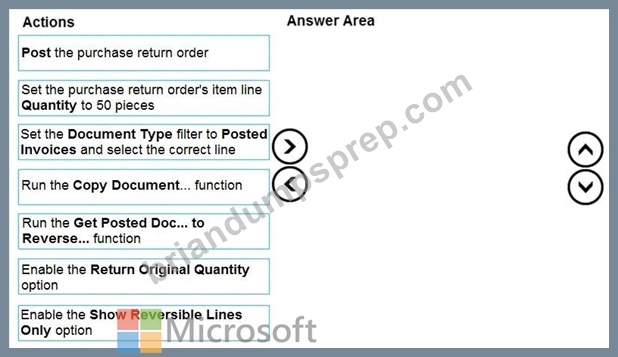
Answer:
Explanation:
Explanation
Reference:
https://docs.microsoft.com/en-gb/dynamics365/business-central/purchasing-how-process-purchase-returns-cance
NEW QUESTION # 77
......
MB-800 Question Bank: Free PDF Download Recently Updated Questions: https://www.briandumpsprep.com/MB-800-prep-exam-braindumps.html
MB-800 Brain Dump: A Study Guide with Tips & Tricks for passing Exam: https://drive.google.com/open?id=1POeoupnoVr0t8h08PEWBuBYonxVqaIl7
