

Positive Aspects of Valid Dumps AD0-E556 Exam Dumps! [Nov-2023]
First Attempt Guaranteed Success in AD0-E556 Exam 2023
NEW QUESTION # 16
Refer to the case study.
UNICORN FINTECH COMPANY PROFILE
Unicorn Fintech is a mobile-only financial-servicesstartup created by a consortium of consumer banks to resell savings, checking, loan, transfer/remittance, and other services from a secure smartphone app. The company is venture-funded, and plans to reach profitability before a planned IPO in two years.
Business issues and requirements
Marketing is responsible for acquiring new customers 0 through online, television advertising, and email campaigns, and for cross-selling new services to customers through IM, email, and in-app campaigns.
Evaluating the success of these campaigns has been a persistent problem: although the company can track revenue by product line, it can't attribute those revenues to campaigns: for example, did a new loan come from onboarding a new customer, or by cross-selling a savings-account customer? Marketing currently uses crude, manual tools and guesswork to evaluate the quality and lifespan of new leads, and even the deliverability of emails in its external campaigns. As a result, the department can't allocate spending to the most productive campaigns, or decide how much different touchpoints in multi-stage campaigns contribute to revenue. Operational processes to connect lead data to CRM and other databases are entirely manual.
Staffing and leadership
Unicorn has fewer than 200 employees, and roles aren't always defined in traditional ways. Since customer acquisition and cross-selling are primarily through electronic channels, Marketing and IT roles especially often overlap. The traditional Sales role falls entirely to Marketing, and IT is responsible for the Salesforce CRM system, Google Analytics, and a handful of third-party integrations. The CMO and CIO work closely together on most initiatives, and budgets are typically project-driven rather than fixed annually. Individual contributors to Marketing campaigns include the Marketing Operations Manager, responsible for lead scoring and analytics. Key IT contacts include the CRM Administrator and Web Developer. Incidental contributors are the Corporate Attorney, who signs off on opt-in/out and DMARC policies.
Revenue sources
Unicorn earns commissions on financial services delivered by the banking consortium through its apps, including fixed finders' fees for what the company calls "skips"-customers who initially engage with Unicorn, but then "skip" to receive services directly from a consortium bank. Unicorn needs to attribute revenue from these customers to its own campaigns; currently, it's impossible to attribute ROI to individual campaigns, or provide documentation to claim commissions on "skips." Current and aspirational marketing technology Current Marketing technology consists of Marketable,an open-source lead management solution supported by a set of spreadsheets and scripts developed in-house. Marketable offers lead tracking and source attribution, but not multi-touch source attribution. Unicorn Fintech Marketing has difficulty linking the different stages of customer campaign journeys, and relies on scripts to translate Marketable's "sales alerts" into next steps it could use in multi-touch campaigns. IT has worked out scripts to input Marketable qualified leads into Salesforce, but the system is brittle and often requires manual intervention.
Current campaign management processes
A typical email campaign:
* Addresses a purchased (for customer acquisition) or0 in-house (for cross-sell) list. Purchased lists range from
300,000 to 1.5 million addresses
* Is sent from multiple data centers in the US and Canada
* Includes an "unsubscribe" opt-out below the message
* Is static; there are no formula fields
* Uses no deliverability authentication, nor integration 0 with any email management platform.
All campaigns to date direct respondents to a single 0 landing page with the company's "all markets" message.
More sophisticated targeting is a high priority.
Current lead management and attribution
Unicorn's lead-management process follows
Marketable's "out of the box" defaults: lead evaluation levels 1 through 3, lifecycle stages "unqualified" and
"qualified." The qualification processes are manual, and highly subjective: Marketing staff classify leads according to prospect email responses, including free-form comments. "Sales" followup is by email forms prompting higher levels of engagement. The company intends to phase out Marketable and replace spreadsheets and scripts with native features of whatever solution set it adopts.
Attribution processes are binary: response to a campaign email or web visit is rated a success if it results in a sale: there is no success rating assigned to TV ads that result in web visits, for example. Cost are not allocated to individual campaigns.
The Marketing department plans to expand outreach to social media (Facebook, Twitter, Instagram, in-house and third-party financial blogs), and wants to make sure it can assess the ROI of these channels, and the overall social media program.
Current governance processes
Currently, the Marketing department assigns content development and campaign management duties to team members on a campaign-by-campaign basis. All team members (and IT) have access to all assets and tools, which sometimes leads to duplication and conflicts. The CMO realizes that a more specialization will be necessary to support the social media campaigns, but hasn't decided on the optimal organizational model.
Input of qualified leads from Marketable into
Salesforce is by manual cut-and-paste, assisted by scripts; inconsistency of input practices across Marketing team members is a known problem; individual members have their own "go-to" fields: where one member might check "TV ad" as Lead Source, another would put that in the comments field.
CMO
The CMO's most important concerns are:
* The current solution has too many manual steps to scale with anticipated growth
* Without more sophisticated attribution, the company will overinvest in less productive campaigns, and underinvest in better ones
* In general, analytics integrations are manual, slow, and unreliable
* The current system completely misses "skips"-customers switching from the Unicorn app to consortium banks-an important source of revenue
* Documenting the value of Unicorn's Marketing processes is essential to the success of the planned IPO, and millions of dollars in stock valuation hangs in the balance.
CIO
The CIO is concerned primarily with:
* The amount of time his team spends patching up Marketing campaigns and CRM data transfers, at the expense of other, critical initiatives
* Quality and reliability of the Analytics information his team provides to Marketing MARKETING STAFF Marketing Operations staff concerns:
* Campaigns require so much work that they can't run as many of them as they need to
* Multi-touch cross-selling campaigns (for example, savings accounts to loans) with excellent margins, but no way to know which campaign touches perform best
* Getting swamped with manual record-keeping; for example, spreadsheet mistakes take hours to find and fix
* Poor integration with third-party tools for preparing, sending, and evaluating campaign materials, for Example.
o Webhook not firing,
o Reaching API limit
o Synchronization errors with third-party tools and Salesforce
* Inadequate number of lead stages and qualification levels, making it difficult to evaluate lead value, especially in multi-touch campaigns Despite the absence of an external Sales team, Marketing Operations would like to improve the granularity of their lead tracking, including both lifecycle stages and quality levels, with "no score" and negative levels.
Unicorn starts rebuilding out its Revenue Cycle Model (RCM) to move away from the generic Marketable model. The goal is a model that more accurately mtaches its customer journey. When building out the RCM, Unicorn finds that several of their "Skips" (customers who initially engage with Unicorn, but then "skip" to receive services directly from a consortium bank) seem to only appear at the Engaged phase due to scoring, before reappearing as a 'Closed Won' in their CRM.
As the CRM begins to sync back these Closed Won Opportunities, how should this journey be captured in the Revenue Cycle Model?
- A. The "Skips" should have specific stages in the success path that are the equivalent of MQL, SAL, and Opportunity, but with "Skips" labelled.
- B. The "Skips" should have a detour arrow above the Success Path that moves them directly from
'Engaged' to 'Closed Won'. - C. Manage the "Skips" quickly by moving them through each stage of the Success Path from engaged to
'Closed Won' once identified
Answer: B
Explanation:
Explanation
The "Skips" should have a detour arrow above the Success Path that moves them directly from 'Engaged' to
'Closed Won'. This way, the Revenue Cycle Model can capture the unique journey of these customers who bypass the normal stages of the Success Path and still generate revenue for Unicorn. The detour arrow would also allow for reporting and analysis of the "Skips" segment and their contribution to the overall revenue. The
"Skips" should not have specific stages in the success path that are the equivalent of MQL, SAL, and Opportunity, but with "Skips" labelled, as this would create confusion and redundancy in the model. The
"Skips" do not go through these stages, so they should not be assigned to them. Managing the "Skips" quickly by moving them through each stage of the Success Path from engaged to 'Closed Won' once identified would not be a good solution, as it would distort the accuracy and integrity of the model. The "Skips" do not follow the same criteria and behavior as the other customers who go through each stage, so they should not be treated as such.
NEW QUESTION # 17
UNICORN FINTECH COMPANY PROFILE
Unicorn Fintech is a mobile-only financial-servicesstartup created by a consortium of consumer banks to resell savings, checking, loan, transfer/remittance, and other services from a secure smartphone app. The company is venture-funded, and plans to reach profitability before a planned IPO in two years.
Business issues and requirements
Marketing is responsible for acquiring new customers 0 through online, television advertising, and email campaigns, and for cross-selling new services to customers through IM, email, and in-app campaigns.
Evaluating the success of these campaigns has been a persistent problem: although the company can track revenue by product line, it can't attribute those revenues to campaigns: for example, did a new loan come from onboarding a new customer, or by cross-selling a savings-account customer? Marketing currently uses crude, manual tools and guesswork to evaluate the quality and lifespan of new leads, and even the deliverability of emails in its external campaigns. As a result, the department can't allocate spending to the most productive campaigns, or decide how much different touchpoints in multi-stage campaigns contribute to revenue. Operational processes to connect lead data to CRM and other databases are entirely manual.
Staffing and leadership
Unicorn has fewer than 200 employees, and roles aren't always defined in traditional ways. Since customer acquisition and cross-selling are primarily through electronic channels, Marketing and IT roles especially often overlap. The traditional Sales role falls entirely to Marketing, and IT is responsible for the Salesforce CRM system, Google Analytics, and a handful of third-party integrations. The CMO and CIO work closely together on most initiatives, and budgets are typically project-driven rather than fixed annually. Individual contributors to Marketing campaigns include the Marketing Operations Manager, responsible for lead scoring and analytics. Key IT contacts include the CRM Administrator and Web Developer. Incidental contributors are the Corporate Attorney, who signs off on opt-in/out and DMARC policies.
Revenue sources
Unicorn earns commissions on financial services delivered by the banking consortium through its apps, including fixed finders' fees for what the company calls "skips"-customers who initially engage with Unicorn, but then "skip" to receive services directly from a consortium bank. Unicorn needs to attribute revenue from these customers to its own campaigns; currently, it's impossible to attribute ROI to individual campaigns, or provide documentation to claim commissions on "skips." Current and aspirational marketing technology Current Marketing technology consists of Marketable,an open-source lead management solution supported by a set of spreadsheets and scripts developed in-house. Marketable offers lead tracking and source attribution, but not multi-touch source attribution. Unicorn Fintech Marketing has difficulty linking the different stages of customer campaign journeys, and relies on scripts to translate Marketable's "sales alerts" into next steps it could use in multi-touch campaigns. IT has worked out scripts to input Marketable qualified leads into Salesforce, but the system is brittle and often requires manual intervention.
Current campaign management processes
A typical email campaign:
* Addresses a purchased (for customer acquisition) or0 in-house (for cross-sell) list. Purchased lists range from
300,000 to 1.5 million addresses
* Is sent from multiple data centers in the US and Canada
* Includes an "unsubscribe" opt-out below the message
* Is static; there are no formula fields
* Uses no deliverability authentication, nor integration 0 with any email management platform.
All campaigns to date direct respondents to a single 0 landing page with the company's "all markets" message.
More sophisticated targeting is a high priority.
Current lead management and attribution
Unicorn's lead-management process follows
Marketable's "out of the box" defaults: lead evaluation levels 1 through 3, lifecycle stages "unqualified" and
"qualified." The qualification processes are manual, and highly subjective: Marketing staff classify leads according to prospect email responses, including free-form comments. "Sales" followup is by email forms prompting higher levels of engagement. The company intends to phase out Marketable and replace spreadsheets and scripts with native features of whatever solution set it adopts.
Attribution processes are binary: response to a campaign email or web visit is rated a success if it results in a sale: there is no success rating assigned to TV ads that result in web visits, for example. Cost are not allocated to individual campaigns.
The Marketing department plans to expand outreach to social media (Facebook, Twitter, Instagram, in-house and third-party financial blogs), and wants to make sure it can assess the ROI of these channels, and the overall social media program.
Current governance processes
Currently, the Marketing department assigns content development and campaign management duties to team members on a campaign-by-campaign basis. All team members (and IT) have access to all assets and tools, which sometimes leads to duplication and conflicts. The CMO realizes that a more specialization will be necessary to support the social media campaigns, but hasn't decided on the optimal organizational model.
Input of qualified leads from Marketable into
Salesforce is by manual cut-and-paste, assisted by scripts; inconsistency of input practices across Marketing team members is a known problem; individual members have their own "go-to" fields: where one member might check "TV ad" as Lead Source, another would put that in the comments field.
CMO
The CMO's most important concerns are:
* The current solution has too many manual steps to scale with anticipated growth
* Without more sophisticated attribution, the company will overinvest in less productive campaigns, and underinvest in better ones
* In general, analytics integrations are manual, slow, and unreliable
* The current system completely misses "skips"-customers switching from the Unicorn app to consortium banks-an important source of revenue
* Documenting the value of Unicorn's Marketing processes is essential to the success of the planned IPO, and millions of dollars in stock valuation hangs in the balance.
CIO
The CIO is concerned primarily with:
* The amount of time his team spends patching up Marketing campaigns and CRM data transfers, at the expense of other, critical initiatives
* Quality and reliability of the Analytics information his team provides to Marketing MARKETING STAFF Marketing Operations staff concerns:
* Campaigns require so much work that they can't run as many of them as they need to
* Multi-touch cross-selling campaigns (for example, savings accounts to loans) with excellent margins, but no way to know which campaign touches perform best
* Getting swamped with manual record-keeping; for example, spreadsheet mistakes take hours to find and fix
* Poor integration with third-party tools for preparing, sending, and evaluating campaign materials, for Example.
o Webhook not firing,
o Reaching API limit
o Synchronization errors with third-party tools and Salesforce
* Inadequate number of lead stages and qualification levels, making it difficult to evaluate lead value, especially in multi-touch campaigns Despite the absence of an external Sales team, Marketing Operations would like to improve the granularity of their lead tracking, including both lifecycle stages and quality levels, with "no score" and negative levels.
With help from the Adobe Marketo Engage Architects, Unicorn has an audit of their system and finds the following issues:
* Mass uploading spreadsheet data with mistakes and failure to check with Salesforce data caused a large number of Person records with the wrong Country field value in place. This reduces how many MQL leads are being sent in a timely fashion to the right team in their CRM.
* Many fields in Marketo Engage must be hidden and field blocked. The fields are not currently being used in day-to-day Programs, Lists, or Assets.
* The current Webinar and Tradeshow Event Program templates are not optimized. They have too many steps for the actions captured, and do not use 'My Tokens' as effectively as they could.
Only one person is making these changes. There is no need for 'quick wins' In which order of importance should these issues be fixed?
- A. Country Data, Program Templates, Make Old Fields Hidden
- B. Country Data, Make Old Fields Hidden, Program Templates
- C. Make Old Fields Hidden, Program Templates, Country Data
Answer: B
Explanation:
Explanation
The order of importance for fixing these issues should be based on the impact they have on the lead generation and management process. The Country Data issue is the most urgent, because it affects the lead routing and qualification process, and may result in lost or delayed opportunities. The Make Old Fields Hidden issue is the next important, because it affects the data quality and security, and may cause confusion or errors in the future.
The Program Templates issue is the least important, because it affects the efficiency and consistency of thecampaign execution, but not the core functionality or performance. References:
https://docs.marketo.com/display/public/DOCS/Best+Practices%3A+Data+Managementhttps://docs.marketo.com
NEW QUESTION # 18
After evaluating global operations, the Marketing Operations team for a mid-sized organization determines that changes must be made to how many operational processes are running in their Adobe Marketo Engage instance. Some processes that cleanse and enrich the data being synced to Marketo Engage from Salesforce must be retired. The team negotiates a new process with Sales Operations to make values in certain data fields compulsory before a salesperson can save a new Contact in the CRM.
Before pushing this change live, which stakeholders must be enabled in the new process?
- A. Marketing team, Sales Operations, and the Head of Sales
- B. Sales Operations, Sales Representatives, Sales Managers, and Data Analysts
- C. CMO, CFO, Sales Operations, Head of Sales, and the Marketing team
- D. The CMO. Data Analysts, the Head of Sales, and the Marketing team
Answer: B
Explanation:
Explanation
The stakeholders that must be enabled in the new process are Sales Operations, Sales Representatives, Sales Managers, and Data Analysts. This is because these are the roles that are directly involved in creating, managing, and reporting on Contacts in the CRM. Sales Operations is responsible for setting up and enforcing the new data validation rules. Sales Representatives and Sales Managers are responsible for entering and updating Contact data in compliance with the new rules. Data Analysts are responsible for monitoring and evaluating the data quality and performance metrics. The other options are not as relevant or necessary as this one, because they do notinclude all the key roles or they include roles that are not directly affected by the new process.
References: https://docs.marketo.com/display/public/DOCS/Best+Practices%3A+Data+Management
https://docs.marketo.com/display/public/DOCS/Salesforce+Sync%3A+Overview
NEW QUESTION # 19
An Adobe Marketo Engage Consultant is reviewing all programs in an instance. Each campaign in each program contains at least three flow steps:
* If Acquisition Program is Empty, change Acquisition Program to the current program's name
* Change the status in the program (based on the action)
* Write an Interesting Moment
These flow steps happen in almost every campaign.
How can the Consultant edit the programs for scalability and efficiency?
- A. Create global Interesting Moments campaigns based on specific triggers and using tokens
- B. Remove the program status change because this will be handled by the Acquisition Program update
- C. Create a global program and coordinating campaigns to update the acquisition program to the latest program touched
Answer: C
Explanation:
Explanation
The Consultant can edit the programs for scalability and efficiency by creating a global program and coordinating campaigns to update the acquisition program to the latest program touched. This will allow the Consultant to streamline and optimize the process of updating the acquisition program for each lead, instead of having multiple flow steps in each campaign. The global program can use triggers and filters to capture leads from different sources and channels, and use tokens to dynamically update the acquisition program based on the latest program touched. This will also reduce the number of campaigns in the queue and improve the campaign performance.
References: https://docs.marketo.com/display/public/DOCS/Acquisition+Program
https://docs.marketo.com/display/public/DOCS/Global+Programs
NEW QUESTION # 20
A company buys a webinar solution that connects to its Adobe Marketo Engage instance via API. The Marketing VP wants to quickly scale the volume of webinars from once a month for North America to three times a month globally. All webinars will be in English. The company markets to three different regions, and the content of all assets such as the landing page and emails need the option to vary the content for different combinations of region and industry.
The Marketing VP wants to see the results of each webinar reported at the global level. The Demand Generation Manager wants to see the results of each webinar reported at the regional level.
Which two actions should the Marketo Engage Architect recommend to meet these requirements? (Choose two.)
- A. Create a webinar email template with program tokens to populate content by region and industry
- B. Create a global webinar program template that contains each region's local assets when it is cloned
- C. Create a webinar email asset in the program template that uses Velocity Scripting to populate region and industry
- D. Create a webinar email template with snippets to populate content by region and industry
- E. Create a regional webinar program template with a consistent naming convention
Answer: C,E
Explanation:
Explanation
The two actions that the Marketo Engage Architect should recommend to meet these requirements are to create a webinar email asset in the program template that uses Velocity Scripting to populate region and industry and to create a regional webinar program template with a consistent naming convention. These actions will help the Architect to quickly scale the volume of webinars from once a month for North America to three times a month globally, as well as to vary the content of assets for different combinations of region and industry. Creating a webinar email asset in the program template that uses Velocity Scripting to populate region and industry will enable the Architect to dynamically insert content based on the lead's region and industry segmentation fields, instead of creating separate email assets for each segment. Creating a regional webinar program template with a consistent naming convention will enable the Architect to easily clone and customize the program for each region, as well as to report on the results of each webinar at the global and regional level.
References: https://docs.marketo.com/display/public/DOCS/Webinar+Programs
https://docs.marketo.com/display/public/DOCS/Velocity+Scripting
https://docs.marketo.com/display/public/DOCS/Program+Templates
NEW QUESTION # 21
A consultant conducts an audit on a company's Adobe Marketo Engage instance and discovers:
* The instance hits its API limit twice a month, affecting leads from multiple third-party integrations from being consistently created or updated automatically.
* The field "Country' is set as a text field, which results in inconsistent variations and misspellings of the country value, leading to the inability to route leads to the proper regional sales team.
* There is a Segmentation called "Reqion", which is defined by the "Country" field values; due to the inconsistency of the field, a majority of the person records sit in the "Default" segment.
* Lead routing is based on the "Region" segment, and there is no logic set in the routing to account for the
"Default" leads.
After sharing these findings with a group of stakeholders, the stakeholders share:
* The Data Science team uses the Marketo Engage API to pull data out of the instance twice a month for an executive dashboard that tracks quarterly goals.
* The Sales team is extremely below target for qualified leads because the volume routed to them is so low.
* The Web team has reported on below-average form conversions because too many fields are open text.
* The Marketing team wants to send nurture emails that are localized based on the "Region" Segmentation.
The end of the quarter is 1 month away.
What is the first action the consultant should take?
- A. Advise the company to increase its API limits to solve the API issue
- B. Change the ' Country" field from a text field to a string field to standardize the values
- C. Advise the Data Science team to minimize their API query to reduce the consumption of the API limit
- D. Create a daily re-occurring batch that standardizes "Country" into clean values
Answer: C
Explanation:
Explanation
The first action the consultant should take is to advise the Data Science team to minimize their API query to reduce the consumption of the API limit. This is because hitting the API limit twice a month affects leads from multiple third-party integrations from being consistently created or updated automatically, which impacts the lead routing and nurturing processes. By reducing the API query, the consultant can ensure that the integrations are not disrupted and that leads are not lost or delayed. The other options are not as urgent or effective as this one, because they do not address the root cause of the problem or they require more time and resources to implement.
References:https://docs.marketo.com/display/public/DOCS/Understanding+Marketo+API+Limits
NEW QUESTION # 22
The VP of Marketing is concerned about the workload of the marketing team and wants to hire an agency to assist the team by building campaigns and programs within their Adobe Marketo Engage instance. The biggest concern is adding users who may be able to access and accidentally break established templates, nurture campaigns, and scoring. Therefore, the users will only be able to work in the Marketing Activities area.
The agency will have access to building programs, campaigns, emails, and landing pages.
What is the best set of user role permissions for the agency users?
- A. Web Campaign Editor, Access Email, Activate Trigger Campaign, Clone Marketing Asset
- B. Edit Marketing Asset, Access Email, Access Landing Page, Export Analytics Data
- C. Access Email, Access Landing Page, Web Campaign Editor, Edit Marketing Asset
- D. Edit Marketing Asset, Edit Campaign, Activate Trigger Campaign, Clone Marketing Asset
Answer: C
NEW QUESTION # 23
An Adobe Marketo Engage Architect is working for Too Big to Fail Co., an enterprise company that has an
8-year-old Marketo Engage instance (A). Too Big to Fail Co. recently purchased start up Treat Snack LTD, which has 100 employees and its own Marketo Engage instance (B). The Architect needs to merge the two instances and maintain business continuity. No additional budget, funding, or resources are available for the merger and migration.
The Architect needs to determine the most important actions to take for the minimum viable solution to meet the business needs. The two instances need to be merged in 3 months.
Which actions should the Architect take?
- A. * Dedupe instance (A) database and import the leads into instance (B)
* Determine the highest-performing assets and rebuild the campaigns relevant to those assets
* Audit the instance for critical business functions
* Rebuild in instance (B) - B. * Dedupe the instance (B) database and import the leads into instance (A)
* Determine the highest-performing assets and rebuild the campaigns relevant to those assets
* Audit the instance for critical business functions
* Rebuild in instance (A) - C. * Spin up a new instance (C)
* Dedupe leads across both instances (A and B) and import into the new instance (C)
* Audit highest-performing assets and key critical campaigns in both instances
* Rebuild in the new instance (C)
Answer: B
Explanation:
Explanation
The most important actions to take for the minimum viable solution are to dedupe the instance (B) database and import the leads into instance (A), determine the highest-performing assets and rebuild the campaigns relevant to those assets, audit the instance for critical business functions, and rebuild in instance (A). This is because instance (A) is older and likely has more data, assets, and integrations than instance (B), and it would be easier and faster to migrate the smaller instance into the larger one. Deduping the leads and determining the highest-performing assets are essential steps to avoid data quality issues and maintain campaign performance.
Auditing the instance for critical business functions and rebuilding them in instance (A) are necessary steps to ensure business continuity and alignment. The other options are not as feasible or efficient as this one, because they involve creating a new instance or migrating the larger instance into the smaller one, which would require more time, resources, and complexity.
References: https://docs.marketo.com/display/public/DOCS/Instance+Migration+Guide
https://docs.marketo.com/display/public/DOCS/Best+Practices%3A+Data+Management
NEW QUESTION # 24 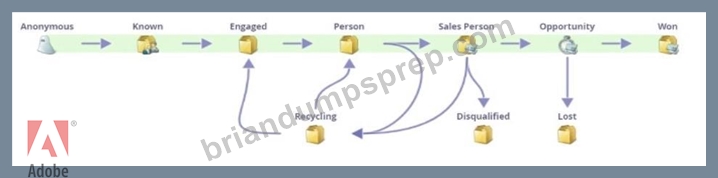
Refer to the lifecycle model above.
A company wants improve the efficiency of its sales follow-up and enhance its velocity reporting across the funnel. The company currently uses the out-of-box Adobe Marketo Engage success with detours modeler. The stages are defined as:
1. Anonymous: Leads whose web activity is tracked, but whose identity is not known yet
2. Known: Leads for whom we have an email address or other information that allows us to market to them
3. Engaged: Leads that have engaged us by filling out a form, clicking a link in an email, or visiting our website at least 10 times within a week
4. Lead: Leads with scores greater than 25
5. Sales Person: Leads with scores greater than 30
6. Opportunity: Leads who also have an opportunity attached to them. The Max Age is set to 7 days before it moves to "Lost".
7. Won: Leads who are attached to opportunities that we have closed and Won
8. Recycling: People with scores below 25 that need to be nurtured
9. Disqualified: People who are not a fit for our products and services and we no longer want to market to them
0. Lost: People who are attached to opportunities that we have lost
Once leads reach the "Sales Person" stage, 50% of them do not get followed up by Sales until 7 days later. The Sales leader wants a salesperson to follow up with leads within 4 days.
Which two modifications should the Adobe Marketo Engage Consultant make to the lifecycle model to achieve these goals? (Choose two.)
- A. Modify the Sales Person" stage from Type: Gate to Type: SLA and set Max Age to 4 days
- B. Add an additional stage between "Sales Person" and "Opportunity". Set type to SLA and set Max 1 ' Age to 3 days
- C. Modify the "Sales Person" stage from Type: Inventory to Type: SLA and set Max Age to 4 days
- D. Add an additional stage between "Opportunity" and "Won". Set type to SLA and set Max Age to 3 '-' days
- E. Modify the "Opportunity" stage and update the Max Age from 7 days to 4 days
Answer: A,B
Explanation:
Explanation
The two modifications that the Adobe Marketo Engage Consultant should make to the lifecycle model to achieve these goals are to add an additional stage between "Sales Person" and "Opportunity" and to modify the Sales Person stage from Type: Gate to Type: SLA. These modifications will help the company to improve the efficiency of its sales follow-up and enhance its velocity reporting across the funnel, as well as to ensure that a salesperson follows up with leads within 4 days. Adding an additional stage between "Sales Person" and
"Opportunity" will enable the Consultant to create a separate stage for leads that are being worked by Sales but have not yet become opportunities, as well as to measure the conversion rate and velocity of this stage.
Setting type to SLA and setting Max Age to 3 days for this stage will enable the Consultant to define a service level agreement (SLA) between Marketing and Sales, as well as to monitor and measure the compliance and performance of Sales. Modifying the Sales Person stage from Type: Gate to Type: SLA will enable the Consultant to specify the maximum time that a lead can stay in the Sales Person stage before it is moved to another stage or marked as non-compliant. Setting Max Age to 4 days for this stage will enable the Consultant to align with the Sales leader's goal of following up with leads within 4 days.
References: https://docs.marketo.com/display/public/DOCS/Revenue+Cycle+Modeler
https://docs.marketo.com/display/public/DOCS/Revenue+Cycle+Modeler+Best+Practices
NEW QUESTION # 25
A company has a Contact Us form that contains a text field called "Comments" where prospects describe their needs to provide sales with context for follow-up. When this form is completed, a Marketing Qualified Lead (MQL) is generated and sent to sales. The "Comments" field is a custom text field. Leads often write lengthy descriptions that exceed 140 characters. The "Comments" field is not synced to CRM. Another field called
"Notes" is synced to CRM. This is also a text field. The "Notes" field is often used by Sales and is commonly overwritten by Sales. Both Sales and Marketing agree that the "Comments" field is important and want to give the prospect space to describe their needs.
An Adobe Marketo Engage Architect needs to set up an interesting moment that is triggered upon the Contact Us form fill that contains the "Comments" value to give Sales immediate context of the inquiry.
Which two actions must the Marketo Engage Architect take to fulfill this request? (Choose two.) Which two actions must the Marketo Engage Architect take to fulfill this request? (Choose two.)
- A. Create the "Comments" field in CRM, sync it to Marketo, and have Marketo Support remap it
- B. Switch the field mapping on the Marketo form from "Comments" to "Notes"
- C. Change the "Comments" field type from text to string to capture longer comments
- D. Use a token in the Interesting Moment to populate info from the "Comments" field
- E. Have Marketo Support re-map the "Comments" field in Marketo to the "Notes" CRM field
Answer: A,D
Explanation:
Explanation
The two actions that the Marketo Engage Architect must take to fulfill this request are to use a token in the Interesting Moment to populate info from the "Comments" field and to create the "Comments" field in CRM, sync it to Marketo, and have Marketo Support remap it. These actions will allow the Architect to set up an interesting moment that is triggered upon the Contact Us form fill that contains the "Comments" value to give Sales immediate context of the inquiry. Using a token in the Interesting Moment will enable the Architect to dynamically insert the value of the "Comments" field into the interesting moment description. Creating the
"Comments" field in CRM, syncing it to Marketo, and having Marketo Support remap it will enable the Architect to preserve the value of the "Comments" field in both systems and avoid overwriting the "Notes" field that is used by Sales.
References: https://docs.marketo.com/display/public/DOCS/Interesting+Moments
https://docs.marketo.com/display/public/DOCS/Use+Tokens+in+Interesting+Moments
https://docs.marketo.com/display/public/DOCS/Field+Mapping
NEW QUESTION # 26
Refer to the case study.
UNICORN FINTECH COMPANY PROFILE
Unicorn Fintech is a mobile-only financial-servicesstartup created by a consortium of consumer banks to resell savings, checking, loan, transfer/remittance, and other services from a secure smartphone app. The company is venture-funded, and plans to reach profitability before a planned IPO in two years.
Business issues and requirements
Marketing is responsible for acquiring new customers 0 through online, television advertising, and email campaigns, and for cross-selling new services to customers through IM, email, and in-app campaigns.
Evaluating the success of these campaigns has been a persistent problem: although the company can track revenue by product line, it can't attribute those revenues to campaigns: for example, did a new loan come from onboarding a new customer, or by cross-selling a savings-account customer? Marketing currently uses crude, manual tools and guesswork to evaluate the quality and lifespan of new leads, and even the deliverability of emails in its external campaigns. As a result, the department can't allocate spending to the most productive campaigns, or decide how much different touchpoints in multi-stage campaigns contribute to revenue. Operational processes to connect lead data to CRM and other databases are entirely manual.
Staffing and leadership
Unicorn has fewer than 200 employees, and roles aren't always defined in traditional ways. Since customer acquisition and cross-selling are primarily through electronic channels, Marketing and IT roles especially often overlap. The traditional Sales role falls entirely to Marketing, and IT is responsible for the Salesforce CRM system, Google Analytics, and a handful of third-party integrations. The CMO and CIO work closely together on most initiatives, and budgets are typically project-driven rather than fixed annually. Individual contributors to Marketing campaigns include the Marketing Operations Manager, responsible for lead scoring and analytics. Key IT contacts include the CRM Administrator and WebDeveloper. Incidental contributors are the Corporate Attorney, who signs off on opt-in/out and DMARC policies.
Revenue sources
Unicorn earns commissions on financial services delivered by the banking consortium through its apps, including fixed finders' fees for what the company calls "skips"-customers who initially engage with Unicorn, but then "skip" to receive services directly from a consortium bank. Unicorn needs to attribute revenue from these customers to its own campaigns; currently, it's impossible to attribute ROI to individual campaigns, or provide documentation to claim commissions on "skips." Current and aspirational marketing technology Current Marketing technology consists of Marketable,an open-source lead management solution supported by a set of spreadsheets and scripts developed in-house. Marketable offers lead tracking and source attribution, but not multi-touch source attribution. Unicorn Fintech Marketing has difficulty linking the different stages of customer campaign journeys, and relies on scripts to translate Marketable's "sales alerts" into next steps it could use in multi-touch campaigns. IT has worked out scripts to input Marketable qualified leads into Salesforce, but the system is brittle and often requires manual intervention.
Current campaign management processes
A typical email campaign:
* Addresses a purchased (for customer acquisition) or0 in-house (for cross-sell) list. Purchased lists range from
300,000 to 1.5 million addresses
* Is sent from multiple data centers in the US and Canada
* Includes an "unsubscribe" opt-out below the message
* Is static; there are no formula fields
* Uses no deliverability authentication, nor integration 0 with any email management platform.
All campaigns to date direct respondents to a single 0 landing page with the company's "all markets" message.
More sophisticated targeting is a high priority.
Current lead management and attribution
Unicorn's lead-management process follows
Marketable's "out of the box" defaults: lead evaluation levels 1 through 3, lifecycle stages "unqualified" and
"qualified." The qualification processes are manual, and highly subjective: Marketing staff classify leads according to prospect email responses, including free-form comments. "Sales" followup is by email forms prompting higher levels of engagement. The company intends to phase out Marketable and replace spreadsheets and scripts with native features of whatever solution set it adopts.
Attribution processes are binary: response to a campaign email or web visit is rated a success if it results in a sale: there is no success rating assigned to TV ads that result in web visits, for example. Cost are not allocated to individual campaigns.
The Marketing department plans to expand outreach to social media (Facebook, Twitter, Instagram, in-house and third-party financial blogs), and wants to make sure it can assess the ROI of these channels, and the overall social media program.
Current governance processes
Currently, the Marketing department assigns content development and campaign management duties to team members on a campaign-by-campaign basis. All team members (and IT) have access to all assets and tools, which sometimes leads to duplication and conflicts. The CMO realizes that a more specialization will be necessary to support the social media campaigns, but hasn't decided on the optimal organizational model.
Input of qualified leads from Marketable into
Salesforce is by manual cut-and-paste, assisted by scripts; inconsistency of input practices across Marketing team members is a known problem; individual members have their own "go-to" fields: where one member might check "TV ad" as Lead Source, another would put that in the comments field.
CMO
The CMO's most important concerns are:
* The current solution has too many manual steps to scale with anticipated growth
* Without more sophisticated attribution, the company will overinvest in less productive campaigns, and underinvest in better ones
* In general, analytics integrations are manual, slow, and unreliable
* The current system completely misses "skips"-customers switching from the Unicorn app to consortium banks-an important source of revenue
* Documenting the value of Unicorn's Marketing processes is essential to the success of the planned IPO, and millions of dollars in stock valuation hangs in the balance.
CIO
The CIO is concerned primarily with:
* The amount of time his team spends patching up Marketing campaigns and CRM data transfers, at the expense of other, critical initiatives
* Quality and reliability of the Analytics information his team provides to Marketing MARKETING STAFF Marketing Operations staff concerns:
* Campaigns require so much work that they can't run as many of them as they need to
* Multi-touch cross-selling campaigns (for example, savings accounts to loans) with excellent margins, but no way to know which campaign touches perform best
* Getting swamped with manual record-keeping; for example, spreadsheet mistakes take hours to find and fix
* Poor integration with third-party tools for preparing, sending, and evaluating campaign materials, for Example.
o Webhook not firing,
o Reaching API limit
o Synchronization errors with third-party tools and Salesforce
* Inadequate number of lead stages and qualification levels, making it difficult to evaluate lead value, especially in multi-touch campaigns Despite the absence of an external Sales team, Marketing Operations would like to improve the granularity of their lead tracking, including both lifecycle stages and quality levels, with "no score" and negative levels.
Multiple Unicorn teams are manually placing Sources in multiple areas. A small set of IT members decides to use an API that triggers when the Source field is not one of a list of 9 values, or is empty. When this is the case, the API is called via webhook to confirm if there is information in the Comments, Status, or custom field
'Sales update1 and then replaces the Source with what is found in those fields, in the above order of importance.
These IT team members are ready to switch on the solution after testing successfully in a staging area, but request feedback from the Marketing team and the Adobe Marketo Engage solution architect.
The larger IT team and Marketing stakeholders are alerted to a wider review to determine if it matches the current needs across each team.
Which steps should be taken first?
- A. Recommend they build a new field to update this data into the CRM that can not be seen by Marketo Engage. This way, Marketing and IT can see the data in CRM without affecting any operations outside CRM.
- B. Perform an audit of Marketo engage automation and analyze the impact, outline any issues with the proposed changes, and make recommendations and next steps. Send this report to the rest of the stakeholders and IT team to make sure it aligns with their needs before agreeing to anything.
- C. Make sure the larger IT team switches on the solution in a low-activity timeframe, where as little automated and marketing work is happening. Once the updates are complete, monitor the change of data as it is switched on, to check for any unexpected effects in the Marketo Engage instance.
Answer: B
Explanation:
Explanation
Performing an audit of Marketo Engage automation and analyzing the impact, outlining any issues with the proposed changes, and making recommendations and next steps is the best step to take first. This way, the solution architect can ensure that the solution is aligned with the business requirements and best practices, and that it does not cause any negative consequences for the data quality, campaign performance, or reporting accuracy. Sending this report to the rest of the stakeholders and IT team would also allow for feedback and collaboration before implementing any changes. Making sure the larger IT team switches on the solution in a low-activity timeframe, where as little automated and marketing work is happening would not be a good step to take first, as it would risk disrupting the existing workflows and data integrity without proper testing and validation. Recommending they build a new field to update this data into the CRM that can not be seen by Marketo Engage would not be a good step to take first, as it would create data silos and prevent Marketo Engage from using the source information for segmentation, personalization, or attribution.
NEW QUESTION # 27
When reviewing completion of a REST API Webhook, two URLs can be used to perform an initial validation and make sure leads will pass correctly.
Which two combinations of URL and associated parameters should be used to validate the REST API?
(Choose two.)
- A. Identity URL with Client ID and Client Secret
- B. Endpoint URL with Access Token and Client ID
- C. Endpoint URL with Access Token and Your Email Address
- D. Endpoint URL with Client ID, Your Email Address, and Client Secret
- E. Identity URL with Client Score and Client ID
Answer: A,C
Explanation:
Explanation
The two combinations of URL and associated parameters that should be used to validate the REST API are Endpoint URL with Access Token and Your Email Address and Identity URL with Client ID and Client Secret. These combinations will allow the user to perform an initial validation and make sure leads will pass correctly through the REST API Webhook. The Endpoint URL with Access Token and Your Email Address will allow the user to test the functionality of the endpoint service and verify that the leads can be submitted successfully. The Identity URL with Client ID and Client Secret will allow the user to obtain an access token for authentication and authorization purposes.
References: https://developers.marketo.com/rest-api/
https://docs.marketo.com/display/public/DOCS/Webhooks
NEW QUESTION # 28
An Adobe Marketo Engage Consultant is assigned to audit an existing Marketo Engage instance. The instance is 2 years old and follows a de-centralized model for program execution. Therefore, all marketers within the organization have been trained to operate and build in the Marketo Engage instance independently. During the audit, the consultant discovers:
1. Naming convention does not exist. Therefore, all program names are named arbitrarily.
2. There are four Marketo Engage Admins: The marketing operations manager, the demand generation manager, the CRM administrator, and the IT manager. All four admins have access to everything and have been creating fields on their own to fit individual business needs.
3. There is one workspace for the entire instance. However, the company has paid for additional workspaces.
4. There are two Revenue Lifecycle Models: a prospect lifecycle and a customer lifecycle.
The CMO wants to prioritize the following goals:
1. Ability to pull quick reports for prospect programs and customer programs from a reporting tool like Tableau.
2. Change the operating model from de-centralized to centralized so the marketing operations manager and CRM administrator are the only two people managing the operational side of the Marketo Engage instance and a new agency will manage the campaign execution on the behalf of marketing.
Which three recommendations should the Consultant make? (Choose three.)
- A. Create a naming convention that tags customer vs prospect campaigns
- B. Create a folder structure to organize customer vs prospect campaigns
- C. Reduce the access for the demand generation manager and IT manager to a limited role that cannot create fields
- D. Increase the access for the marketing operations manager and CRM administrator to super admin so they can override the field creations from others
- E. Create two workspaces: A prospect workspace and a customer workspace
- F. Create two workspaces: An operational workspace and a marketing workspace
Answer: A,C,E
Explanation:
Explanation
The three recommendations that the Consultant should make are to create two workspaces: A prospect workspace and a customer workspace, to create a naming convention that tags customer vs prospect campaigns, and to reduce the access for the demand generation manager and IT manager to a limited role that cannot create fields. These recommendations will help the company to achieve their goals of pulling quick reports for prospect programs and customer programs from a reporting tool like Tableau, and changing the operating model from de-centralized to centralized. Creating two workspaces: A prospect workspace and a customer workspace will enable the company to segment and organize their programs based on their target audience, as well as to leverage their existing workspaces feature. Creating a naming convention that tags customer vs prospect campaigns will enable the company to standardize and identify their programs based on their purpose, as well as to facilitate reporting and analysis. Reducing the access for the demand generation manager and IT manager to a limited role that cannot create fields will enable the company to centralize and control their field management process, as well as to avoid field duplication or inconsistency.
References: https://docs.marketo.com/display/public/DOCS/Workspaces+and+Partitions
https://docs.marketo.com/display/public/DOCS/Naming+Conventions
https://docs.marketo.com/display/public/DOCS/Roles+and+Permissions
NEW QUESTION # 29
An Architect notices that deliverability is slowly decreasing over time. After pulling a year of reports, the Administrator notices that the number of emails per month has increased from 3 to 10. The unsubscribe rates nearly double each quarter. Per the CMO, the amount of marketing activity must remain the same.
Which two actions can the Architectr take to make sure emails reach people in their database? (Choose two.)
- A. Make marketing emails operational so people who have unsubscribed continue to receive ^ communications
- B. Work with the marketing team to decrease the number of email sends per month
- C. Create a "marketable" smart list to include on every send that excludes multiple soft bounces
- D. Decrease behavior scores when someone unsubscribes from an email
- E. Implement communication limits so people receive fewer emails
Answer: B,E
Explanation:
Explanation
Implementing communication limits and decreasing the number of email sends per month are two actions that can help improve deliverability by reducing email fatigue and spam complaints. Making marketing emails operational or decreasing behavior scores are not recommended as they can harm the sender reputation and engagement. Creating a "marketable" smart list is not relevant to the deliverability issue.
https://experienceleague.adobe.com/docs/marketo-events/events/marketo-and-mochas/2023/deliverability-part-o
NEW QUESTION # 30
FADE IN:
CUSTOMER CONTACT - SCORING DILEMMA
In a virtual meeting, a marketing executive in
business attire, speaks directly to the camera. The screen displays the executive's name and title (CMO).
CMO
It's nice to meet you. Welcome to our growing B2B tech SaaS company. I heard you've spoken with the CIO.
Good. Listen, I have a specific concern I'd like you to evaluate.
Marketing, my team, we're really ramping up our demand generation activities. We have a lot of leads coming in and we are pushing over an increasing amount of marketing qualified leads to the inside sales team.
(shakes their head)
The volume we're pushing-inside sales is just
getting inundated, and they don't know how to prioritize or who to follow up with first. My team has a lot of data and context to send over to the sales team, but it's just too much for them to take in all at once. I don't want us to waste these opportunities. Tell me, how can I use scoring to help with this challenge we're in9 FADE OUT:
THE END
At Treat Snack Inc, a company that specializes in unique local ethnic snacks, the new CMO is being bombarded by complaints from the sales team that a high volume of MQLs are being delivered to the sales team. There is no context around why they reached MQL, what it is about them, as well as what they did that caused them to MQL. The CMO decides to overhaul the entire scoring system and build a new method from scratch.
The Sales team is interviewed to understand what indicated a good person to speak with who has a high likelihood of wanting to take a meeting. The Sales team reports that their best leads have the following traits in order of priority starting with the most helpful trait:
1. People who attended a webinar on different types of treats enjoyed in different global regions
2. People who have a title of director and higher, followed by whether the account was larger than 1000 employees
3. People who work for companies that look similar to companies that they have sold to previously
4. People who have a high interest in their chocolate tasting line of products
5. People who search the web for wholesale suppliers of gourmet treats
In which order should the different types of scoring be rolled out?
- A. Behavior, Demographic, Predictive, Product, Intent
- B. Predictive, Behavior Demographic, Intent, Product
- C. Behavior, Intent, Demographic, Product, Predictive
Answer: A
Explanation:
Explanation
The order of the different types of scoring should be based on the priority and feasibility of the traits that the Sales team identified. Behavior scoring should be rolled out first, because it captures the most helpful trait of attending a webinar, as well as other actions that indicate interest and engagement. Demographic scoring should be rolled out next, because it captures the second most helpful trait of title and company size, as well as other attributes that indicate fit and qualification. Predictive scoring should be rolled out third, because it captures the third most helpful trait of working for similar companies, as well as other factors that indicate propensity and likelihood to buy.Product scoring should be rolled out fourth, because it captures the fourth most helpful trait of having a high interest in their chocolate tasting line of products, as well as other preferences and needs that indicate product fit and value. Intent scoring should be rolled out last, because it captures the fifth most helpful trait of searching the web for wholesale suppliers of gourmet treats, as well as other signals that indicate buying intent and readiness.
References: https://docs.marketo.com/display/public/DOCS/Scoring+Overview
https://docs.marketo.com/display/public/DOCS/Best+Practices%3A+Lead+Scoring
NEW QUESTION # 31
Refer to the case study.
UNICORN FINTECH COMPANY PROFILE
Unicorn Fintech is a mobile-only financial-servicesstartup created by a consortium of consumer banks to resell savings, checking, loan, transfer/remittance, and other services from a secure smartphone app. The company is venture-funded, and plans to reach profitability before a planned IPO in two years.
Business issues and requirements
Marketing is responsible for acquiring new customers 0 through online, television advertising, and email campaigns, and for cross-selling new services to customers through IM, email, and in-app campaigns.
Evaluating the success of these campaigns has been a persistent problem: although the company can track revenue by product line, it can't attribute those revenues to campaigns: for example, did a new loan come from onboarding a new customer, or by cross-selling a savings-account customer? Marketing currently uses crude, manual tools and guesswork to evaluate the quality and lifespan of new leads, and even the deliverability of emails in its external campaigns. As a result, the department can't allocate spending to the most productive campaigns, or decide how much different touchpoints in multi-stage campaigns contribute to revenue. Operational processes to connect lead data to CRM and other databases are entirely manual.
Staffing and leadership
Unicorn has fewer than 200 employees, and roles aren't always defined in traditional ways. Since customer acquisition and cross-selling are primarily through electronic channels, Marketing and IT roles especially often overlap. The traditional Sales role falls entirely to Marketing, and IT is responsible for the Salesforce CRM system, Google Analytics, and a handful of third-party integrations. The CMO and CIO work closely together on most initiatives, and budgets are typically project-driven rather than fixed annually. Individual contributors to Marketing campaigns include the Marketing Operations Manager, responsible for lead scoring and analytics. Key IT contacts include the CRM Administrator and Web Developer. Incidental contributors are the Corporate Attorney, who signs off on opt-in/out and DMARC policies.
Revenue sources
Unicorn earns commissions on financial services delivered by the banking consortium through its apps, including fixed finders' fees for what the company calls "skips"-customers who initially engage with Unicorn, but then "skip" to receive services directly from a consortium bank. Unicorn needs to attribute revenue from these customers to its own campaigns; currently, it's impossible to attribute ROI to individual campaigns, or provide documentation to claim commissions on "skips." Current and aspirational marketing technology Current Marketing technology consists of Marketable,an open-source lead management solution supported by a set of spreadsheets and scripts developed in-house. Marketable offers lead tracking and source attribution, but not multi-touch source attribution. Unicorn Fintech Marketing has difficulty linking the different stages of customer campaign journeys, and relies on scripts to translate Marketable's "sales alerts" into next steps it could use in multi-touch campaigns. IT has worked out scripts to input Marketable qualified leads into Salesforce, but the system is brittle and often requires manual intervention.
Current campaign management processes
A typical email campaign:
* Addresses a purchased (for customer acquisition) or0 in-house (for cross-sell) list. Purchased lists range from
300,000 to 1.5 million addresses
* Is sent from multiple data centers in the US and Canada
* Includes an "unsubscribe" opt-out below the message
* Is static; there are no formula fields
* Uses no deliverability authentication, nor integration 0 with any email management platform.
All campaigns to date direct respondents to a single 0 landing page with the company's "all markets" message.
More sophisticated targeting is a high priority.
Current lead management and attribution
Unicorn's lead-management process follows
Marketable's "out of the box" defaults: lead evaluation levels 1 through 3, lifecycle stages "unqualified" and
"qualified." The qualification processes are manual, and highly subjective: Marketing staff classify leads according to prospect email responses, including free-form comments. "Sales" followup is by email forms prompting higher levels of engagement. The company intends to phase out Marketable and replace spreadsheets and scripts with native features of whatever solution set it adopts.
Attribution processes are binary: response to a campaign email or web visit is rated a success if it results in a sale: there is no success rating assigned to TV ads that result in web visits, for example. Cost are not allocated to individual campaigns.
The Marketing department plans to expand outreach to social media (Facebook, Twitter, Instagram, in-house and third-party financial blogs), and wants to make sure it can assess the ROI of these channels, and the overall social media program.
Current governance processes
Currently, the Marketing department assigns content development and campaign management duties to team members on a campaign-by-campaign basis. All team members (and IT) have access to all assets and tools, which sometimes leads to duplication and conflicts. The CMO realizes that a more specialization will be necessary to support the social media campaigns, but hasn't decided on the optimal organizational model.
Input of qualified leads from Marketable into
Salesforce is by manual cut-and-paste, assisted by scripts; inconsistency of input practices across Marketing team members is a known problem; individual members have their own "go-to" fields: where one member might check "TV ad" as Lead Source, another would put that in the comments field.
CMO
The CMO's most important concerns are:
* The current solution has too many manual steps to scale with anticipated growth
* Without more sophisticated attribution, the company will overinvest in less productive campaigns, and underinvest in better ones
* In general, analytics integrations are manual, slow, and unreliable
* The current system completely misses "skips"-customers switching from the Unicorn app to consortium banks-an important source of revenue
* Documenting the value of Unicorn's Marketing processes is essential to the success of the planned IPO, and millions of dollars in stock valuation hangs in the balance.
CIO
The CIO is concerned primarily with:
* The amount of time his team spends patching up Marketing campaigns and CRM data transfers, at the expense of other, critical initiatives
* Quality and reliability of the Analytics information his team provides to Marketing MARKETING STAFF Marketing Operations staff concerns:
* Campaigns require so much work that they can't run as many of them as they need to
* Multi-touch cross-selling campaigns (for example, savings accounts to loans) with excellent margins, but no way to know which campaign touches perform best
* Getting swamped with manual record-keeping; for example, spreadsheet mistakes take hours to find and fix
* Poor integration with third-party tools for preparing, sending, and evaluating campaign materials, for Example.
o Webhook not firing,
o Reaching API limit
o Synchronization errors with third-party tools and Salesforce
* Inadequate number of lead stages and qualification levels, making it difficult to evaluate lead value, especially in multi-touch campaigns Despite the absence of an external Sales team, Marketing Operations would like to improve the granularity of their lead tracking, including both lifecycle stages and quality levels, with "no score" and negative levels.
A key revenue source for Unicorn is "skips". This source is made up of customers who initially engage with Unicorn, but then "skip" to receive services directly from a consortium bank. Unicorn wants to attribute this revenue from these customers to their campaigns. Unicorn IT has done the due diligence to be able to receive access to this data.
For Marketo's revenue attribution model and overall data architecture, in which location should this data be available to Marketo?
- A. Stored in a Marketo Custom Object
- B. Stored directly on the Person record
- C. Stored on a Salesforce Custom Object and synced to Marketo via the native sync
- D. Stored on the Salesforce Opportunity Object and synced to Marketo via the native sync
Answer: D
Explanation:
Explanation
Storing the data on the Salesforce Opportunity Object and syncing to Marketo via the native sync is the best location for Marketo's revenue attribution model and overall data architecture. This way, Marketo can use the Opportunity Influence Analyzer and the Revenue Cycle Modeler to attribute revenue to campaigns based on the opportunity data. Storing the data directly on the Person record would not allow for revenue attribution, as Marketo does not use person-level fields for this purpose. Storing the data on a Salesforce Custom Object or a Marketo Custom Object would require additional configuration and integration to link the data to the person and the opportunity.
NEW QUESTION # 32
An Adobe Marketo Engage Architect is working for Too Big to Fail Co., an enterprise company that has an
8-year-old Marketo Engage instance (A). Too Big to Fail Co. recently purchased start up Treat Snack LTD, which has 100 employees and its own Marketo Engage instance (B). The Architect needs to merge the two instances and maintain business continuity. No additional budget, funding, or resources are available for the merger and migration.
The Architect needs to determine the most important actions to take for the minimum viable solution to meet the business needs. The two instances need to be merged in 3 months.
Which actions should the Architect take?
- A. * Dedupe instance (A) database and import the leads into instance (B)
* Determine the highest-performing assets and rebuild the campaigns relevant to those assets
* Audit the instance for critical business functions
* Rebuild in instance (B) - B. * Dedupe the instance (B) database and import the leads into instance (A)
* Determine the highest-performing assets and rebuild the campaigns relevant to those assets
* Audit the instance for critical business functions
* Rebuild in instance (A) - C. * Spin up a new instance (C)
* Dedupe leads across both instances (A and B) and import into the new instance (C)
* Audit highest-performing assets and key critical campaigns in both instances
* Rebuild in the new instance (C)
Answer: B
Explanation:
Explanation
The most important actions to take for the minimum viable solution are to dedupe the instance (B) database and import the leads into instance (A), determine the highest-performing assets and rebuild the campaigns relevant to those assets, audit the instance for critical business functions, and rebuild in instance (A). This is because instance (A) is older and likely has more data, assets, and integrations than instance (B), and it would be easier and faster to migrate the smaller instance into the larger one. Deduping the leads and determining the highest-performing assets are essential steps to avoid data quality issues and maintain campaign performance.
Auditing the instance for critical business functions and rebuilding them in instance (A) are necessary steps to ensure business continuity and alignment. The other options are not as feasible or efficient as this one, because they involve creating a new instance or migrating the larger instance into the smaller one, which would require more time, resources, and complexity.
References: https://docs.marketo.com/display/public/DOCS/Instance+Migration+Guide
https://docs.marketo.com/display/public/DOCS/Best+Practices%3A+Data+Management
NEW QUESTION # 33
Refer to the case study
UNICORN FINTECH COMPANY PROFILE
Unicorn Fintech is a mobile-only financial-servicesstartup created by a consortium of consumer banks to resell savings, checking, loan, transfer/remittance, and other services from a secure smartphone app. The company is venture-funded, and plans to reach profitability before a planned IPO in two years.
Business issues and requirements
Marketing is responsible for acquiring new customers 0 through online, television advertising, and email campaigns, and for cross-selling new services to customers through IM, email, and in-app campaigns.
Evaluating the success of these campaigns has been a persistent problem: although the company can track revenue by product line, it can't attribute those revenues to campaigns: for example, did a new loan come from onboarding a new customer, or by cross-selling a savings-account customer? Marketing currently uses crude, manual tools and guesswork to evaluate the quality and lifespan of new leads, and even the deliverability of emails in its external campaigns. As a result, the department can't allocate spending to the most productive campaigns, or decide how much different touchpoints in multi-stage campaigns contribute to revenue. Operational processes to connect lead data to CRM and other databases are entirely manual.
Staffing and leadership
Unicorn has fewer than 200 employees, and roles aren't always defined in traditional ways. Since customer acquisition and cross-selling are primarily through electronic channels, Marketing and IT roles especially often overlap. The traditional Sales role falls entirely to Marketing, and IT is responsible for the Salesforce CRM system, Google Analytics, and a handful of third-party integrations. The CMO and CIO work closely together on most initiatives, and budgets are typically project-driven rather than fixedannually. Individual contributors to Marketing campaigns include the Marketing Operations Manager, responsible for lead scoring and analytics. Key IT contacts include the CRM Administrator and Web Developer. Incidental contributors are the Corporate Attorney, who signs off on opt-in/out and DMARC policies.
Revenue sources
Unicorn earns commissions on financial services delivered by the banking consortium through its apps, including fixed finders' fees for what the company calls "skips"-customers who initially engage with Unicorn, but then "skip" to receive services directly from a consortium bank. Unicorn needs to attribute revenue from these customers to its own campaigns; currently, it's impossible to attribute ROI to individual campaigns, or provide documentation to claim commissions on "skips." Current and aspirational marketing technology Current Marketing technology consists of Marketable,an open-source lead management solution supported by a set of spreadsheets and scripts developed in-house. Marketable offers lead tracking and source attribution, but not multi-touch source attribution. Unicorn Fintech Marketing has difficulty linking the different stages of customer campaign journeys, and relies on scripts to translate Marketable's "sales alerts" into next steps it could use in multi-touch campaigns. IT has worked out scripts to input Marketable qualified leads into Salesforce, but the system is brittle and often requires manual intervention.
Current campaign management processes
A typical email campaign:
* Addresses a purchased (for customer acquisition) or0 in-house (for cross-sell) list. Purchased lists range from
300,000 to 1.5 million addresses
* Is sent from multiple data centers in the US and Canada
* Includes an "unsubscribe" opt-out below the message
* Is static; there are no formula fields
* Uses no deliverability authentication, nor integration 0 with any email management platform.
All campaigns to date direct respondents to a single 0 landing page with the company's "all markets" message.
More sophisticated targeting is a high priority.
Current lead management and attribution
Unicorn's lead-management process follows
Marketable's "out of the box" defaults: lead evaluation levels 1 through 3, lifecycle stages "unqualified" and
"qualified." The qualification processes are manual, and highly subjective: Marketing staff classify leads according to prospect email responses, including free-form comments. "Sales" followup is by email forms prompting higher levels of engagement. The company intends to phase out Marketable and replace spreadsheets and scripts with native features of whatever solution set it adopts.
Attribution processes are binary: response to a campaign email or web visit is rated a success if it results in a sale: there is no success rating assigned to TV ads that result in web visits, for example. Cost are not allocated to individual campaigns.
The Marketing department plans to expand outreach to social media (Facebook, Twitter, Instagram, in-house and third-party financial blogs), and wants to make sure it can assess the ROI of these channels, and the overall social media program.
Current governance processes
Currently, the Marketing department assigns content development and campaign management duties to team members on a campaign-by-campaign basis. All team members (and IT) have access to all assets and tools, which sometimes leads to duplication and conflicts. The CMO realizes that a more specialization will be necessary to support the social media campaigns, but hasn't decided on the optimal organizational model.
Input of qualified leads from Marketable into
Salesforce is by manual cut-and-paste, assisted by scripts; inconsistency of input practices across Marketing team members is a known problem; individual members have their own "go-to" fields: where one member might check "TV ad" as Lead Source, another would put that in the comments field.
CMO
The CMO's most important concerns are:
* The current solution has too many manual steps to scale with anticipated growth
* Without more sophisticated attribution, the company will overinvest in less productive campaigns, and underinvest in better ones
* In general, analytics integrations are manual, slow, and unreliable
* The current system completely misses "skips"-customers switching from the Unicorn app to consortium banks-an important source of revenue
* Documenting the value of Unicorn's Marketing processes is essential to the success of the planned IPO, and millions of dollars in stock valuation hangs in the balance.
CIO
The CIO is concerned primarily with:
* The amount of time his team spends patching up Marketing campaigns and CRM data transfers, at the expense of other, critical initiatives
* Quality and reliability of the Analytics information his team provides to Marketing MARKETING STAFF Marketing Operations staff concerns:
* Campaigns require so much work that they can't run as many of them as they need to
* Multi-touch cross-selling campaigns (for example, savings accounts to loans) with excellent margins, but no way to know which campaign touches perform best
* Getting swamped with manual record-keeping; for example, spreadsheet mistakes take hours to find and fix
* Poor integration with third-party tools for preparing, sending, and evaluating campaign materials, for Example.
o Webhook not firing,
o Reaching API limit
o Synchronization errors with third-party tools and Salesforce
* Inadequate number of lead stages and qualification levels, making it difficult to evaluate lead value, especially in multi-touch campaigns Despite the absence of an external Sales team, Marketing Operations would like to improve the granularity of their lead tracking, including both lifecycle stages and quality levels, with "no score" and negative levels.
Unicorn has been having an issue with data quality coming from their Adobe Marketo Engage instance. An audit finds that a key issue is that Marketers and IT members lacked knowledge in best practice processes for the following tasks:
* Importing data to Marketo Engage or CRM in incorrect format or with old information
* Setting up forms to comply with Data Standardization (such as String Country fields to fill out)
* Importing large purchased lists without any minimal validation
Unicorn agrees with the auditor's recommendations to roll out enablement as part of a way to solve the problems.
Which two steps should be a part of this enablement? (Choose two.)
- A. Set up a Roles and Permissions workshop with the CMO and CIO to capture and enforce the right level of access for level of Marketo Engage usage
- B. Remove access to users who are the 'worst offenders' until they have successfully passed the Marketo Certified Associate Exam
- C. Buy lists from a third-party data provider that are GDPR compliant with no country values
- D. Align IT and Marketing Ops teams on what level of responsibility each team should have on data management in Marketo Engage
- E. Set up training sessions that covers List Import and Form best practices for both day-to-day users and Marketo Engage 'Power Users'
Answer: D,E
Explanation:
Explanation
Setting up training sessions that covers List Import and Form best practices for both day-to-day users and Marketo Engage 'Power Users' is a good step to be part of the enablement, as it would help the users to learn how to avoid common data quality issues and follow the best practices for importing data and creating forms.
Aligning IT and Marketing Ops teams on what level of responsibility each team should have on data management in Marketo Engage is another good step to be part of the enablement, as it would help to clarify the roles and expectations of each team and ensure a consistent and collaborative approach to data quality.
Setting up a Roles and Permissions workshop with the CMO and CIO to capture and enforce the right level of access for level of Marketo Engage usage is not a bad step, but it is not directly related to the data quality issues or the enablement of the users. Removing access to users who are the 'worst offenders' until they have successfully passed the Marketo Certified Associate Exam is not a good step, as it would be punitive and disruptive to the users' work. Buying lists from a third-party data provider that are GDPR compliant with no country values is not a good step, as it would not solve the data quality issues or improve the users' knowledge of best practices.
NEW QUESTION # 34
A marketer is in charge of marketing campaigns for a company that creates customized vinyl figurines. The marketer is launching a multi-channel campaign that will include nurture, webinars, paid social ads, virtual events, and more. The marketer creates a nurture email program that consists of a series of six emails to be sent once a week and wants to understand the impact. The target audience will be put through many campaigns.
When reporting on effectiveness or ineffectiveness of an email nurture, which two valid metrics should the marketer utilize to decide what to do next? (Choose two.)
- A. The number of people entering the nurture
- B. The number of completed calls to action, typically conversions or form fills, driven specifically by '-' the nurture
- C. The number of MQLs that were created by the multi-channel campaign
- D. The number of completed calls to action, typically conversions or form fills, driven by the multi-*-* channel campaign
- E. The number of people who unsubscribed from the nurture
Answer: B,E
Explanation:
Explanation
The two valid metrics that the marketer should utilize to decide what to do next are the number of completed calls to action, typically conversions or form fills, driven specifically by the nurture and the number of people who unsubscribed from the nurture. These metrics will help the marketer to understand the impact and effectiveness of the nurture email program, as well as to identify areas for improvement or optimization. The number of completed calls to action, typically conversions or form fills, driven specifically by the nurture will enable the marketer to measure how well the nurture emails are engaging and persuading leads to take a desired action, such as downloading a whitepaper, registering for a webinar, requesting a demo, etc. The number of people who unsubscribed from the nurture will enable the marketer to measure how well the nurture emails are retaining and satisfying leads, as well as to avoid sending unwanted or irrelevant emails.
References: https://docs.marketo.com/display/public/DOCS/Nurture+Programs
https://docs.marketo.com/display/public/DOCS/Nurture+Program+Best+Practices
NEW QUESTION # 35
A company has a meeting with a third party that wants to begin submitting leads captured through various channels. These leads are aware that the third party will share their information with the company and have provided consent through their engagement. The third party will send the leads through a REST API.
Which steps should the Adobe Marketo Engage Architect take to make sure that the REST API is set up correctly?
- A. Create API User Role, Use an existing API User, Create new Launchpoint Service, Run a Call test with Token and Identity
- B. Create API User Role, Create a new API User, Create new Launchpoint Service, Run a Call test with Identity and Endpoint
- C. Create API User Role, Use an existing API User, Create new Launchpoint Service, Run a Call test with Identity and Endpoint
- D. Create API User Role, Create a new API User, Create new Launchpoint Service, Run a Call test with Token and Endpoint
Answer: B
Explanation:
Explanation
The steps that the Adobe Marketo Engage Architect should take to make sure that the REST API is set up correctly are to create API User Role, create a new API User, create new Launchpoint Service, and run a Call test with Identity and Endpoint. These steps will allow the Architect to configure and test the REST API integration with Marketo Engage. Creating API User Role will enable the Architect to define the permissions and access level for the API User. Creating a new API User will enable the Architect to generate a unique Client ID and Client Secret for authentication. Creating new Launchpoint Service will enable the Architect to register and manage the third-party service in Marketo Engage. Running a Call test with Identity and Endpoint will enable the Architect to verify that the API calls are working properly and that leads can be submitted through various channels.
References: https://developers.marketo.com/rest-api/
https://docs.marketo.com/display/public/DOCS/Create+an+API+Only+User+Role
https://docs.marketo.com/display/public/DOCS/Create+a+Custom+Service
https://docs.marketo.com/display/public/DOCS/Webhooks
NEW QUESTION # 36
An Adobe Marketo Engage Architect is working for a car manufacturing company in Japan and wants to solve two problems:
1. Receiving errors when trying to integrate Marketo Engage with Salesforce's Custom Object, the custom object of Salesforce is storing the offers and gifts given to each car owner.
2. Store the periodic details of car services of owners in Marketo Engage. This will help the team to edit the records in Marketo Engage. Also, use Filter and Triggers for sending service reminders on Marketo Engage.
This data at present is maintained offline in Excel.
In which two ways can the Architect solve these challenges? (Choose two.)
- A. Problem 2: The Admin can use Marketo Engage custom activities
- B. Problem 1: Set the language of Marketo Engage sync user to English in Salesforce
- C. Problem 2: The Admin can create a segmentation in Marketo Engage
- D. Problem 1: Set the user profile of the Marketo Engage sync user to Admin in Salesforce
- E. Problem 2: The Admin can use Marketo Engage Custom object
Answer: B,E
Explanation:
Explanation
The two ways that the Architect can solve these challenges are to use Marketo Engage Custom object for problem 2 and to set the language of Marketo Engage sync user to English in Salesforce for problem 1. These ways will help the Architect to integrate Marketo Engage with Salesforce's Custom Object and to store the periodic details of car services of owners in Marketo Engage. Using Marketo Engage Custom object for problem 2 will allow the Architect to create a custom object that can store the car service details of owners in Marketo Engage, as well as to use filters and triggers for sending service reminders. Setting the language of Marketo Engage sync user to English in Salesforce for problem 1 will allow the Architect to avoid errors when trying to integrate Marketo Engage with Salesforce's Custom Object, as the language mismatch can cause sync failures or data corruption.
References: https://docs.marketo.com/display/public/DOCS/Custom+Objects+Overview
https://docs.marketo.com/display/public/DOCS/Salesforce+Sync%3A+Overview
NEW QUESTION # 37
......
Adobe AD0-E556 Exam Syllabus Topics:
| Topic | Details |
|---|---|
| Topic 1 |
|
| Topic 2 |
|
| Topic 3 |
|
| Topic 4 |
|
| Topic 5 |
|
Practice LATEST AD0-E556 Exam Updated 52 Questions: https://www.briandumpsprep.com/AD0-E556-prep-exam-braindumps.html
Real AD0-E556 Exam Questions are the Best Preparation Material: https://drive.google.com/open?id=1JqqrRE_-uLiiAbncs2mO4JTNe3hfIh7x
