

Aug-2022 Pass Microsoft AZ-400 Exam in First Attempt Easily
Free AZ-400 Exam Files Downloaded Instantly 100% Dumps & Practice Exam
What is the Microsoft AZ-400 exam?
Pearson VUE is the official administrator of the Microsoft AZ-400 exam. Therefore, the candidates have to register for and schedule this test on its website. To register for the exam, they must pay the fee of $165. This amount applies to a single delivery of the test. The exam is available in English, Korean, Simplified Chinese, and Japanese. The students can expect around 40-60 questions and the time allowed for the completion of the test is 120 minutes. Different question formats may be included in the delivery of the exam, such as multiple choice, scenario-based, drag and drop, build list, active screen, short answer, and case studies.
The Microsoft AZ-400 exam covers different domains. The candidates must develop high competence in these topic areas before attempting the certification test.
- Developing a Site Reliability Engineering Strategy: 5-10%
This objective is designed to equip the individuals with the skills and knowledge required to develop the strategy for actionable alerting, failure prediction strategy, as well as competence in designing as well as implementing health checks.
- Handling Source Control: 10-15%
Within this domain, the students for the Microsoft AZ-400 exam will be tested based on their knowledge and skills in developing a strategy for modern source control; planning and implementing branching strategies for source codes; configuring repositories; using tools to integrate source control.
- Developing a Compliance & Security Plan: 10-15%
This subject area will evaluate the skills and competence of the test takers in designing an authorization and authentication strategy; designing a strategy for a sensitive information strategy; developing compliance and security; designing the mechanisms for governance enforcement.
- Defining & Implementing Continuous Integration: 20-25%
The questions related to this topic will measure the competence of the learners in designing build automation; designing a strategy for package management; designing a strategy for application infrastructure management; implementing a build strategy; maintaining a build strategy; designing processes for standardizing build throughout an organization.
- Developing an Instrumentation Strategy: 5-10%
The exam questions from this topic will measure the skills and knowledge of the applicants in designing as well as implementing logging; designing as well as implementing telemetry, and integrating logging & monitoring solutions.
Benefits of having Microsoft AZ-400 Certifications
How to get a job with the IT industry in the future. Some Benefits of Microsoft AZ-400 Exam:
- Certification is a worldwide accepted standard in the IT industry
- It will help people to be loyal to their company and employer
- Helpful for people who have experience or have skills in IT industry
- Access to online resources from company's official website
- Higher salary in future in a company with a certification
NEW QUESTION 72
You are developing a full Microsoft .NET Framework solution that includes unit tests.
You need to configure SonarQube to perform a code quality validation of the C# code as part of the build pipelines.
Which four tasks should you perform in sequence? To answer, move the appropriate tasks from the list of tasks to the answer area and arrange them in the correct order.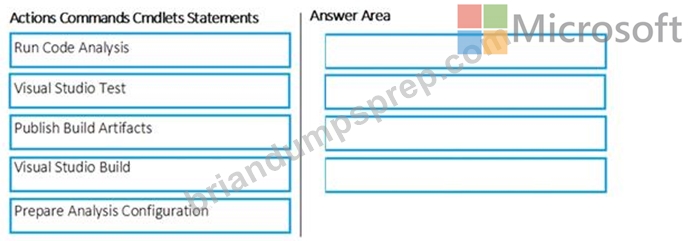
Answer:
Explanation: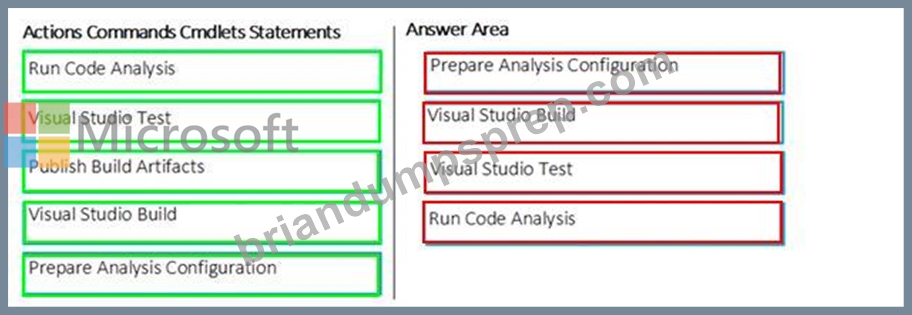
Explanation:
Step 1: Prepare Analysis Configuration
Prepare Analysis Configuration task, to configure all the required settings before executing the build.
This task is mandatory.
In case of .NET solutions or Java projects, it helps to integrate seamlessly with MSBuild, Maven and Gradle tasks.
Step 2: Visual Studio Build
Reorder the tasks to respect the following order:
Prepare Analysis Configuration task before any MSBuild or Visual Studio Build task.
Step 3: Visual Studio Test
Reorder the tasks to respect the following order:
Run Code Analysis task after the Visual Studio Test task.
Step 4: Run Code Analysis
Run Code Analysis task, to actually execute the analysis of the source code.
This task is not required for Maven or Gradle projects, because scanner will be run as part of the Maven/Gradle build.
Note: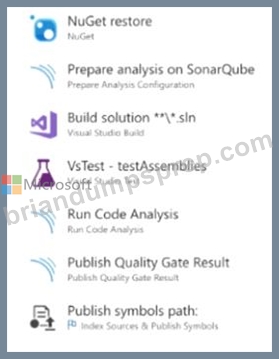
References: https://docs.sonarqube.org/display/SCAN/Analyzing+with+SonarQube+Extension+for+VSTS-TFS
NEW QUESTION 73
Your company wants to use Azure Application Insights to understand how user behaviors affect an application.
Which Application Insights tool should you use to analyze each behavior? To answer, drag the appropriate tools to the correct behaviors. Each tool may be used once, more than once, or not at all. You may need to drag the split bar between panes or scroll to view content.
NOTE: Each correct selection is worth one point.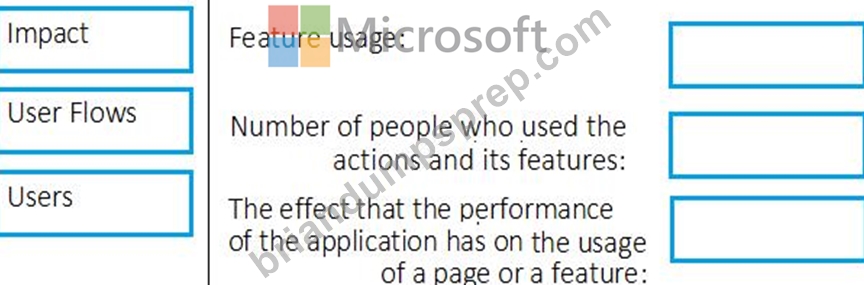
Answer:
Explanation: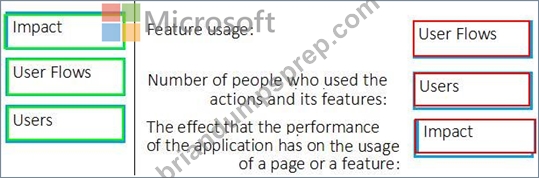
Reference:
https://docs.microsoft.com/en-us/azure/azure-monitor/app/usage-flows
https://docs.microsoft.com/en-us/azure/azure-monitor/app/usage-impact
https://docs.microsoft.com/en-us/azure/azure-monitor/app/usage-troubleshoot
NEW QUESTION 74
You have an existing project in Azure DevOps.
You plan to integrate GitHub as the repository for the project.
You need to ensure that Azure Pipelines runs under the Azure Pipelines identity.
Which authentication mechanism should you use?
- A. Azure Active Directory (Azure AD)
- B. GitHub App
- C. personal access token (PAT)
- D. OAuth
Answer: B
Explanation:
GitHub App uses the Azure Pipelines identity.
Incorrect Answers:
A: Personal access token and OAuth use your personal GitHub identity.
Reference:
https://docs.microsoft.com/en-us/azure/devops/pipelines/repos/github
NEW QUESTION 75
Your company uses GitHub for source control. GitHub repositories store source code and store process documentation. The process documentation is saved as Microsoft Word documents that contain simple flow charts stored as .bmp files.
You need to optimize the integration and versioning of the process documentation and the flow charts. The solution must meet the following requirements:
* Store documents as plain text.
* Minimize the number of files that must be maintained.
* Simplify the modification, merging, and reuse of flow charts.
* Simplify the modification, merging, and reuse of documents.
What should you include in the solution? To answer, select the appropriate options in the answer are a. NOTE: Each correct selection is worth one point.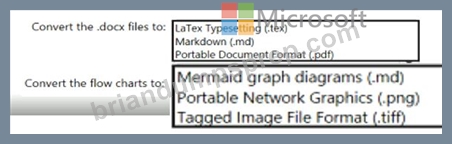
Answer:
Explanation: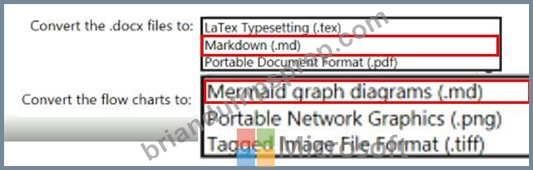
Reference:
https://ourcodingclub.github.io/tutorials/git/
https://mermaid-js.github.io/mermaid/#/
NEW QUESTION 76
You need to implement the code flow strategy for Project2 in Azure DevOps.
Which three actions should you perform in sequence? To answer, move the appropriate actions from the list of actions to the answer area and arrange them in the correct order.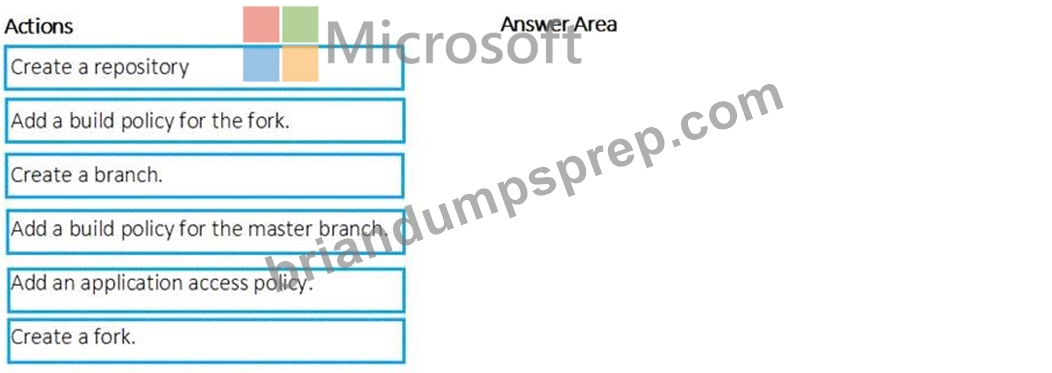
Answer:
Explanation: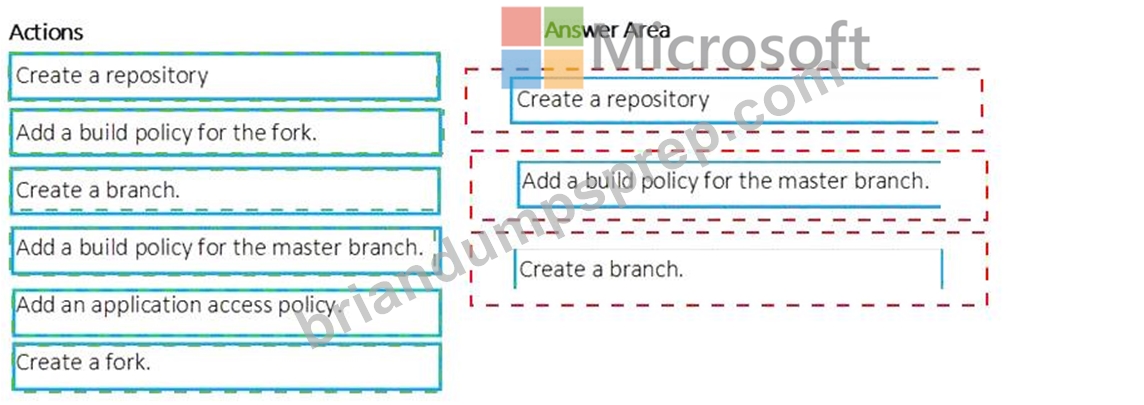
Explanation
NEW QUESTION 77
Which package feed access levels should be assigned to the Developers and Team Leaders groups for the investment planning applications suite? To answer, drag the appropriate access levels to the correct groups. Each access level may be used once, more than once, or not at all. You may need to drag the split bar between panes or scroll to view content.
NOTE: Each correct selection is worth one point.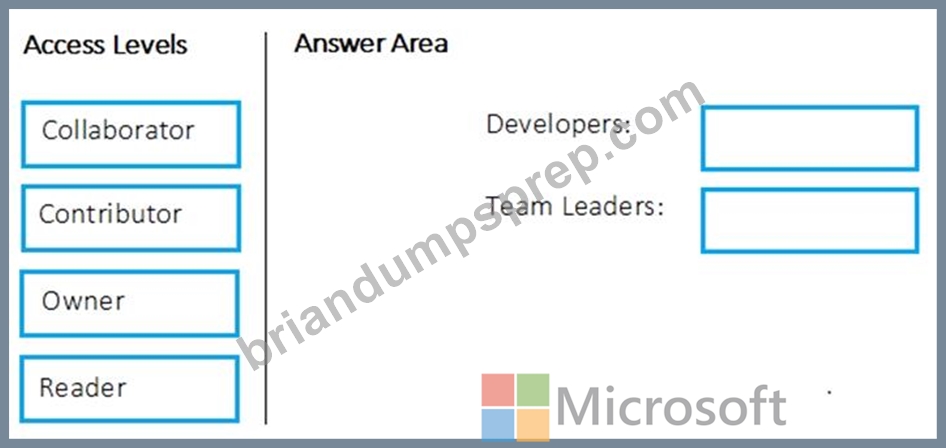
Answer:
Explanation: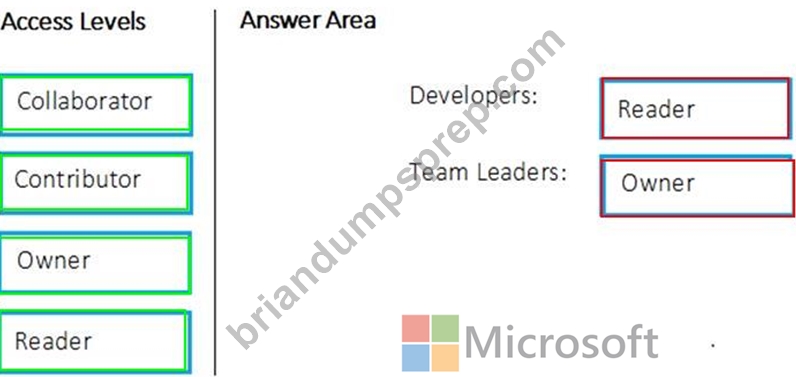
Topic 3, Woodgrove bank
General Overview
Woodgrove Bank is a financial services company that has a main office in the United Kingdom.
Technical Requirements and Planned Changes
Planned Changes
Woodgrove Bank plans to implement the following project management changes:
Implement Azure DevOps for project tracking.
Centralize source code control in private GitHub repositories.
Implement Azure Pipelines for build pipelines and release pipelines.
Woodgrove Bank plans to implement the following changes to the identity environment:
Deploy an Azure AD tenant named woodgrovebank.com.
Sync the Active Directory domain to Azure AD.
Configure App1 to use a service principal.
Integrate GitHub with Azure AD.
Woodgrove Bank plans to implement the following changes to the core apps:
Migrate App1 to ASP.NET Core.
Integrate Azure Pipelines and the third-party build tool used to develop App2.
Woodgrove Bank plans to implement the following changes to the DevOps environment:
Deploy App1 to Azure App Service.
Implement source control for the DB1 schema.
Migrate all the source code from TFS1 to GitHub.
Deploy App2 to an Azure virtual machine named VM1.
Merge the POC branch into the GitHub default branch.
Implement an Azure DevOps dashboard for stakeholders to monitor development progress.
Technical Requirements
Woodgrove Bank identifies the following technical requirements:
The initial databases for new environments must contain both schema and reference data.
An Azure Monitor alert for VM1 must be configured to meet the following requirements:
Be triggered when average CPU usage exceeds 80 percent for 15 minutes.
Calculate CPU usage averages once every minute.
The commit history of the POC branch must replace the history of the default branch.
The Azure DevOps dashboard must display the metrics shown in the following table.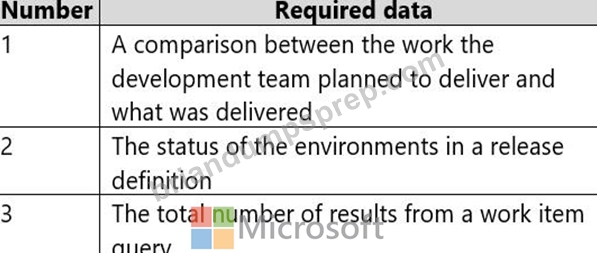
Access to Azure DevOps must be restricted to specific IP addresses.
Page load times for App1 must be captured and monitored.
Administrative effort must be minimized.
NEW QUESTION 78
You have an Azure subscription that contains the resources shown in the following table.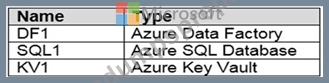
You plan to create a linked service in DF1. The linked service will connect to SQL1 by using Microsoft SQL Server authentication. The password for the SQL Server login will be stored in KV1.
You need to configure DF1 to retrieve the password when the data factory connects to SQL1. The solution must use the principle of least privilege.
How should you configure DF1? To answer, select the appropriate options in the answer area.
NOTE: Each correct selection is worth one point.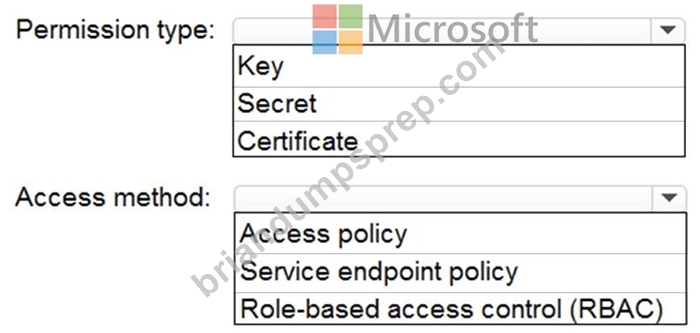
Answer:
Explanation: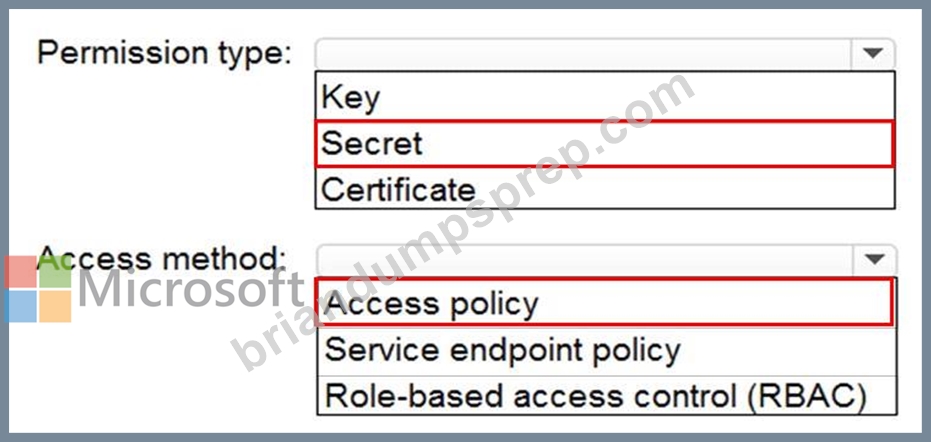
Reference:
https://docs.microsoft.com/en-us/azure/data-factory/store-credentials-in-key-vault
NEW QUESTION 79
You need to configure GitHub to use Azure Active Directory (Azure AD) for authentication. What should you do first?
- A. Modify the Security settings of the GitHub organization.
- B. Create a conditional access policy in Azure AD.
- C. Create an Azure Active Directory B2C (Azure AD B2C) tenant.
- D. Register GitHub in Azure AD.
Answer: D
Explanation:
When you connect to a Git repository from your Git client for the first time, the credential manager prompts for credentials. Provide your Microsoft account or Azure AD credentials.
Note: Git Credential Managers simplify authentication with your Azure Repos Git repositories. Credential managers let you use the same credentials that you use for the Azure DevOps Services web portal. Credential managers support multi-factor authentication through Microsoft account or Azure Active Directory (Azure AD). Besides supporting multi-factor authentication with Azure Repos, credential managers also support two-factor authentication with GitHub repositories.
Reference:
https://docs.microsoft.com/en-us/azure/devops/repos/git/set-up-credential-managers
NEW QUESTION 80
You have a private GitHub repository.
You need to display the commit status of the repository on Azure Boards.
What should you do first?
- A. Add the Azure Pipelines app to the GitHub repository.
- B. Add the Azure Boards app to the repository.
- C. Configure multi-factor authentication (MFA) for your GitHub account.
- D. Create a GitHub action in GitHub.
Answer: B
Explanation:
To connect Azure Boards to GitHub.com, connect and configure from Azure Boards. Or, alternatively, install and configure the Azure Boards app from GitHub. Both methods have been streamlined and support authenticating and operating via the app rather than an individual.
Note (see step 4 below):
Add a GitHub connection:
Sign into Azure Boards.
Choose (1) Project Settings, choose (2) GitHub connections and then (3) Connect your GitHub account.
If this is your first time connecting to GitHub from Azure Boards, you will be asked to sign in using your GitHub credentials. Choose an account for which you are an administrator for the repositories you want to connect to.
The Add GitHub Repositories dialog automatically displays and selects all GitHub.com repositories for which you are an administrator. Unselect any repositories that you don't want to participate in the integration.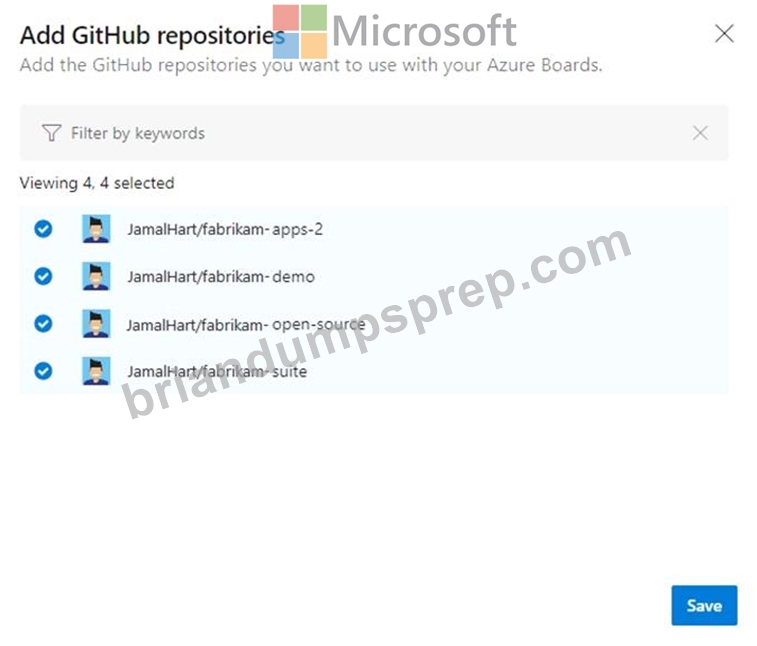
Reference:
https://docs.microsoft.com/en-us/azure/devops/boards/github/connect-to-github
NEW QUESTION 81
You are building an application that has the following assets:
* Source code
* Logs from automated tests and builds
* Large and frequently updated binary assets
* A common library used by multiple applications
Where should you store each asset? To answer, drag the appropriate Azure services to the correct assets. Each service may be used once. You may need to drag the split bar between panes or scroll to view content.
NOTE: Each correct selection is worth one point.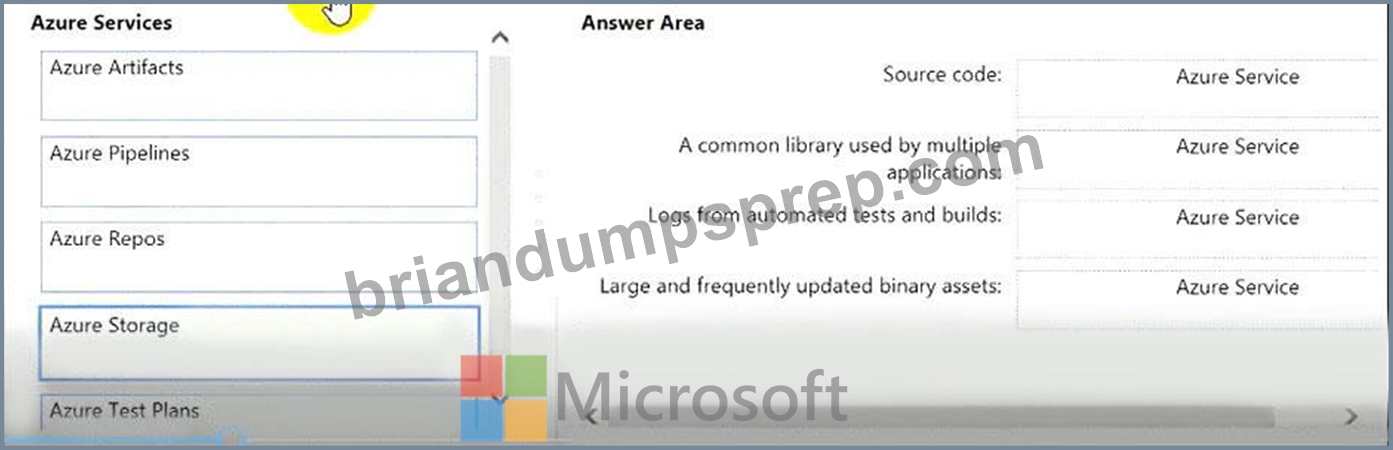
Answer:
Explanation: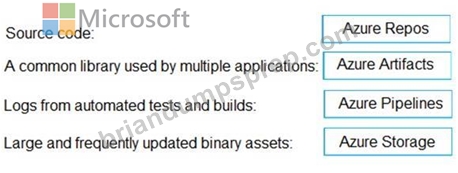
Box 1: Azure Repos
Box 2: Azure Artifacts
Use Azure Artifacts to create, host, and share packages with your team.
Box 3: Azure Pipelines
In the pipeline view you can see all the stages and associated tests. The view provides a summary of the test results Box 4: Azure Storage Reference:
https://docs.microsoft.com/en-us/azure/devops/repos/get-started/what-is-repos
https://azure.microsoft.com/en-us/services/devops/artifacts/
https://docs.microsoft.com/en-us/azure/devops/pipelines/test/review-continuous-test-results-after-build
NEW QUESTION 82
You plan to share packages that you wrote, tested, validated, and deployed by using Azure Artifacts.
You need to release multiple builds of each package by using a single feed. The solution must limit the release of packages that are in development.
What should you use?
- A. upstream sources
- B. local symbols
- C. views
- D. global symbols
Answer: A
Explanation:
Views enable you to share subsets of the NuGet, npm, Maven, Python and Universal Packages package-versions in your feed with consumers. A common use for views is to share package versions that have been tested, validated, or deployed but hold back packages still under development and packages that didn't meet a quality bar.
https://docs.microsoft.com/en-us/azure/devops/artifacts/concepts/views?view=azure-devops
NEW QUESTION 83
Your company has a hybrid cloud between Azure and Azure Stack.
The company uses Azure DevOps for its full CI/CD pipelines. Some applications are built by using Erlang and Hack.
You need to ensure that Erlang and Hack are supported as part of the build strategy across the hybrid cloud. The solution must minimize management overhead.
What should you use to execute the build pipeline?
- A. Azure DevOps self-hosted agents on virtual machines that run on Azure Stack
- B. Azure DevOps self-hosted agents on Azure DevTest Labs virtual machines.
- C. a Microsoft-hosted agent
- D. Azure DevOps self-hosted agents on Hyper-V virtual machines
Answer: A
Explanation:
Explanation/Reference:
Explanation:
Azure Stack offers virtual machines (VMs) as one type of an on-demand, scalable computing resource.
You can choose a VM when you need more control over the computing environment.
References: https://docs.microsoft.com/en-us/azure/azure-stack/user/azure-stack-compute-overview
NEW QUESTION 84
You have a project in Azure DevOps that has three teams as shown in the Teams exhibit. (Click the Teams tab.)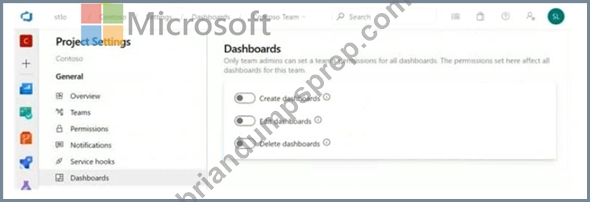
You create a new dashboard named Dash1.
You configure the dashboard permissions for the Contoso project as shown in the Permissions exhibit (Click the Permissions tab.)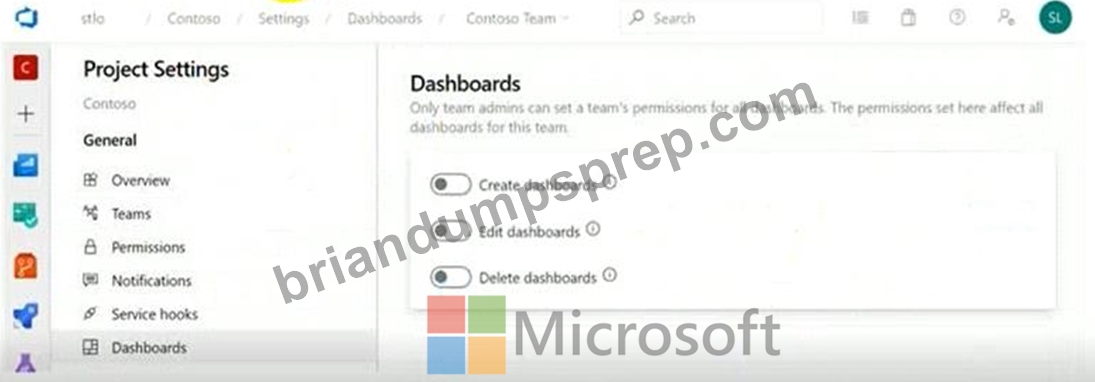
All other permissions have the default values set.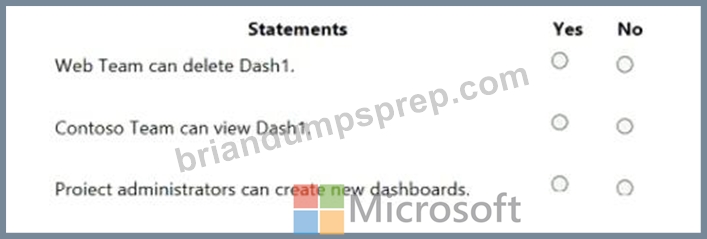
Answer:
Explanation: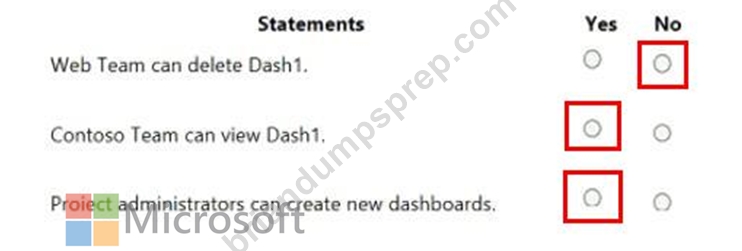
NEW QUESTION 85
You have an Azure Kubernetes Service (AKS) cluster.
You need to deploy an application to the cluster by using Azure DevOps.
Which three actions should you perform in sequence? To answer, move the appropriate actions from the list of actions to the answer area and arrange them in the correct order.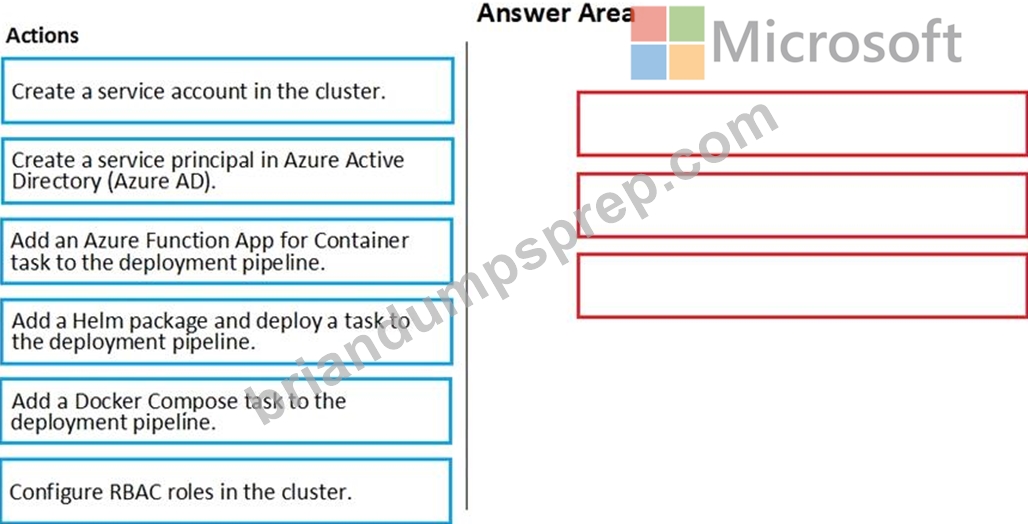
Answer:
Explanation: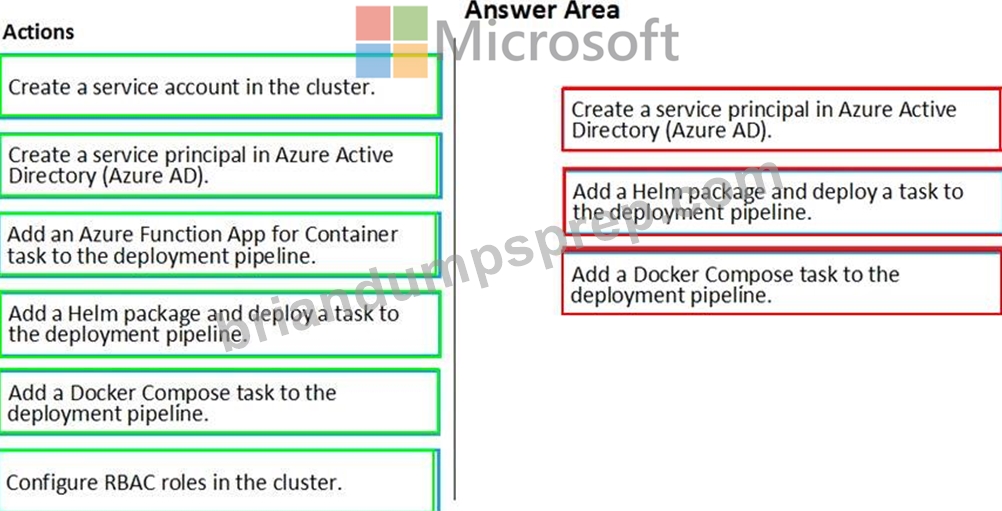
Reference:
https://cloudblogs.microsoft.com/opensource/2018/11/27/tutorial-azure-devops-setup-cicd-pipeline-kubernetes-docker-helm/
NEW QUESTION 86
You plane to store signed images in an Azure Container Registry instance named az4009940427acr1.
You need to modify the SKU for az4009940427acr1 to support the planned images. The solution must minimize costs.
To complete this task, sign in to the Microsoft Azure portal.
Answer:
Explanation:
1. Open Microsoft Azure Portal, and select the Azure Container Registry instance named az4009940427acr1.
2. Under Policies, select Content Trust > Enabled > Save.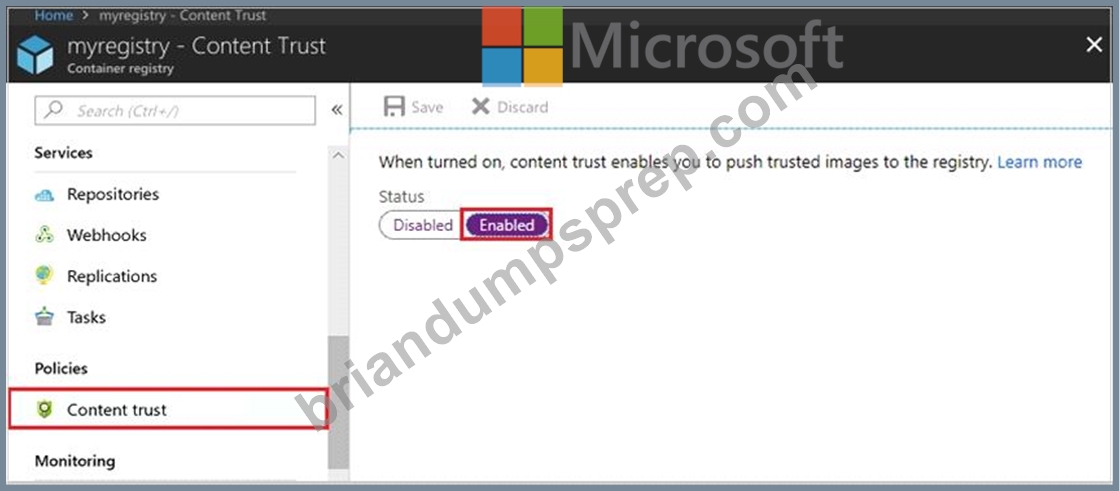
References:
https://docs.microsoft.com/en-us/azure/container-registry/container-registry-content-trust
NEW QUESTION 87
You need to implement the code flow strategy for Project2 in Azure DevOps.
Which three actions should you perform in sequence? To answer, move the appropriate actions from the list of actions to the answer area and arrange in the correct order.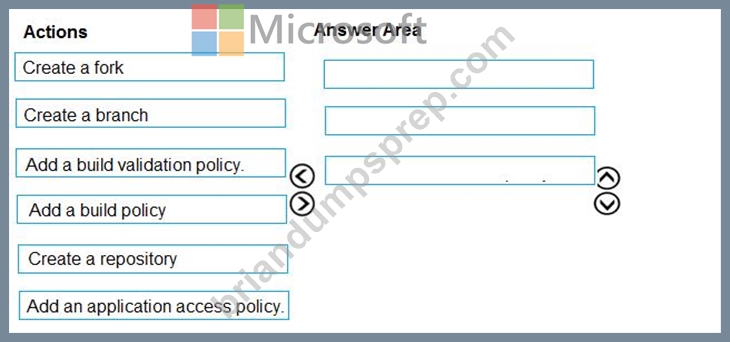
Answer:
Explanation: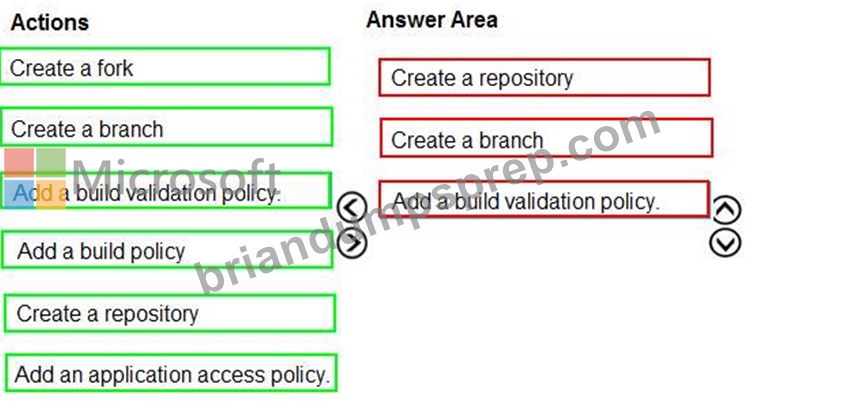
Explanation:
Step 1: Create a repository
A Git repository, or repo, is a folder that you've told Git to help you track file changes in. You can have any number of repos on your computer, each stored in their own folder.
Step 2: Create a branch
Branch policies help teams protect their important branches of development. Policies enforce your team's code quality and change management standards.
Step 3: Add a build validation policy
When a build validation policy is enabled, a new build is queued when a new pull request is created or when changes are pushed to an existing pull request targeting this branch. The build policy then evaluates the results of the build to determine whether the pull request can be completed.
Scenario:
Implement a code flow strategy for Project2 that will:
Enable Team2 to submit pull requests for Project2.
Enable Team2 to work independently on changes to a copy of Project2.
Ensure that any intermediary changes performed by Team2 on a copy of Project2 will be subject to the same restrictions as the ones defined in the build policy of Project2.
References:
https://docs.microsoft.com/en-us/azure/devops/repos/git/manage-your-branches
NEW QUESTION 88
How should you confrere the release retention policy for the investment planning depletions suite? To answer, select the appropriate options in the answer area.
NOTE: Each correct selection is worth one point.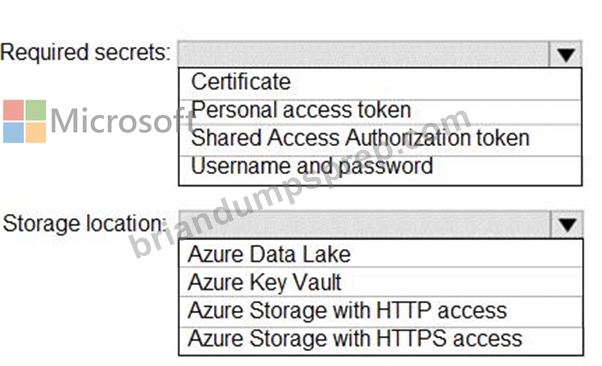
Answer:
Explanation: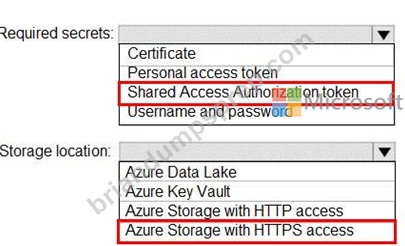
Explanation:
Every request made against a storage service must be authorized, unless the request is for a blob or container resource that has been made available for public or signed access. One option for authorizing a request is by using Shared Key.
Scenario: The mobile applications must be able to call the share pricing service of the existing retirement fund management system. Until the system is upgraded, the service will only support basic authentication over HTTPS.
The investment planning applications suite will include one multi-tier web application and two iOS mobile application. One mobile application will be used by employees; the other will be used by customers.
References: https://docs.microsoft.com/en-us/rest/api/storageservices/authorize-with-shared-key
Topic 2, Overview
Existing Environment
Contoso, Ltd. is a manufacturing company that has a main office in Chicago.
Requirements
Contoso plans to improve its IT development and operations processes implementing Azue DevOps principles. Contoso has an Azure subscription and creates an Azure DevOPs organization.
The Azure DevOps organization includes:
* The Docker extension
* A deployment pool named Pool7 that contains 10 Azure virtual machines that run Windows Server 2016.
The Azure subscription contains an Azure Automation account.
Planned Changes
Contoso plans to create projects in Azure DevOps as shown in the following table.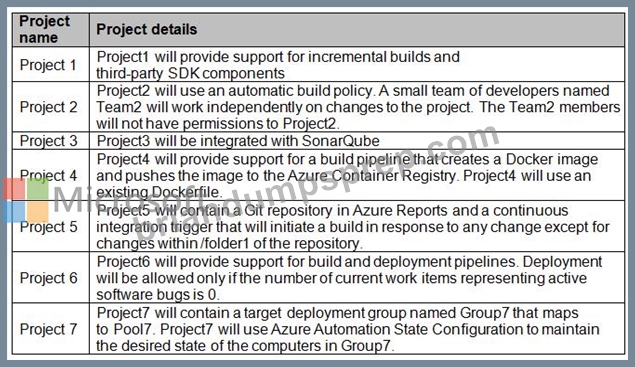
Technical Requirements
Contoso identities the following technical requirements:
* Implement build agents rot Project 1.
* Whenever possible, use Azure resources
* Avoid using deprecated technologies
* Implement a code flow strategy for Project2 that will:
* Enable Team 2 to submit pull requests for Project2.
* Enable Team 2 to work independently on changes to a copy of Project?
* Ensure that any intermediary changes performed by Tram2 on a copy of Project2 will be subject to the same restrictions as the ones defied in the build policy of Project2.
* Whenever possible. Implement automation and minimize administrative effort.
* Implement Protect3, Project5, Project6, and Project7 based on the planned changes.
* Implement Project4 and configure the project to push Docker images to Azure Container Reentry.
NEW QUESTION 89
You have a project Azure DevOps.
You plan to create a build pipeline that will deploy resources by using Azure Resource Manager templates. The templates will reference secretes stored in Azure Key Vault.
Yu need to ensure that you can dynamically generate the resource ID of the key vault during template deployment.
What should you include in the template? To answer, select eh appropriate options in the answer area.
NOTE: Each correct selection is worth one point.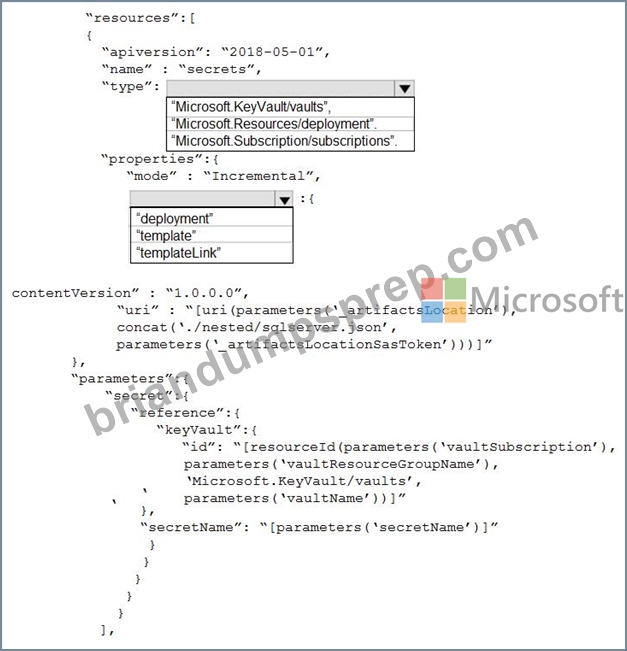
Answer:
Explanation: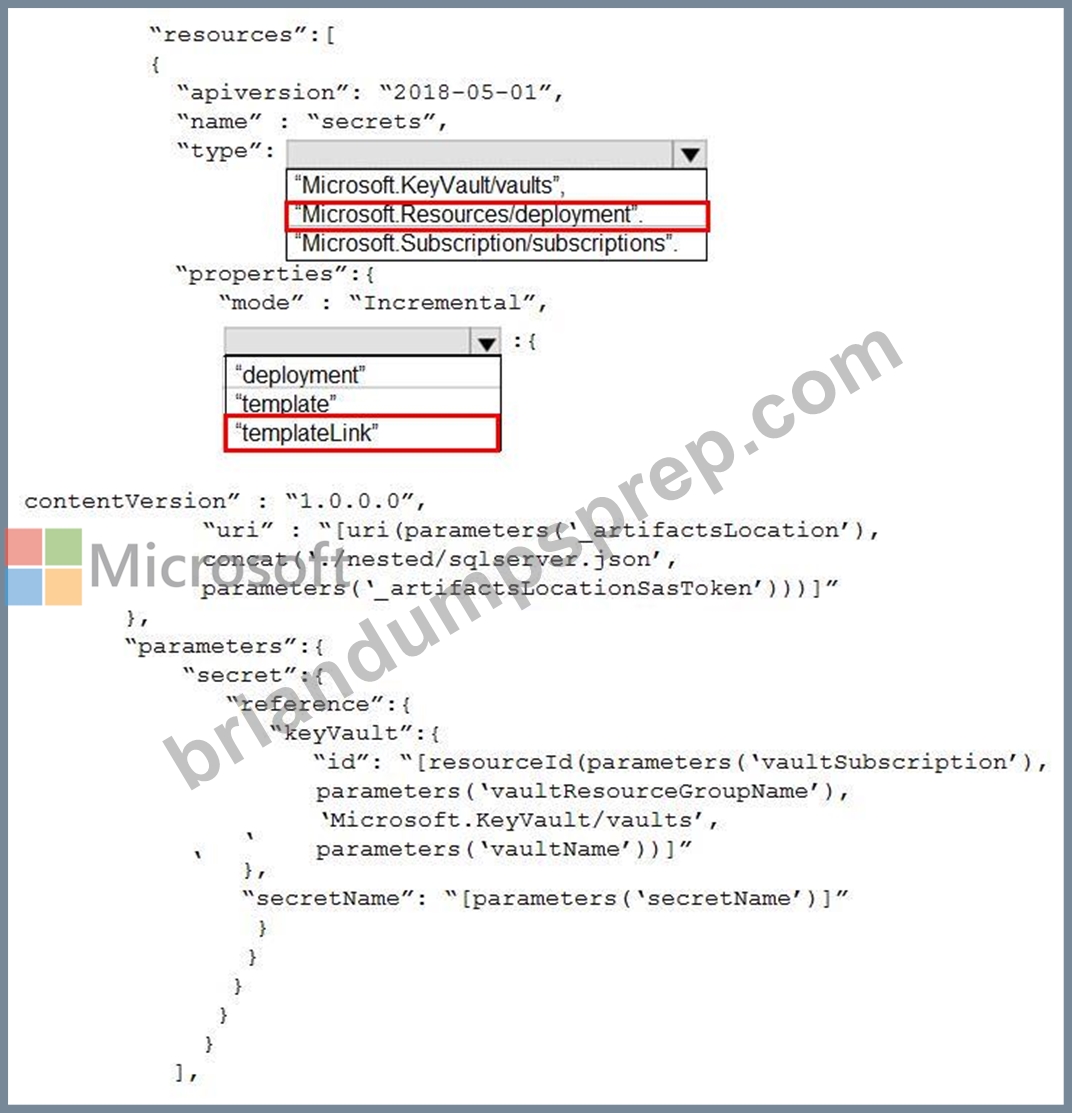
NEW QUESTION 90
You need to ensure that an Azure web app named az400-9940427-main supports rolling upgrades. The solution must ensure that only 10 percent of users who connect to az400-9940427-main use update versions of the app.
The solution must minimize administrative effort.
To complete this task, sign in to the Microsoft Azure portal.
- A. Set up staging environments in Azure App Service
1. Open Microsoft Azure Portal
2. Log into your Azure account, select your app's resource page, in the left pane, select Deployment slots > Add Slot.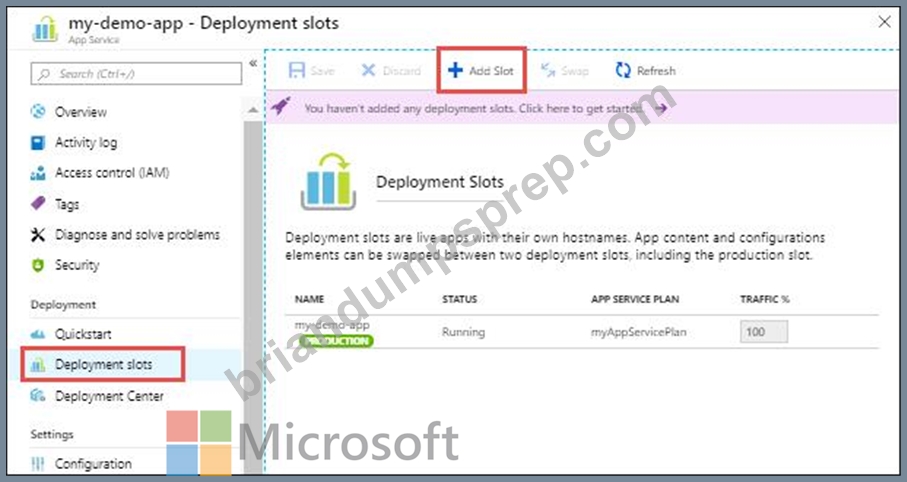
3. In the Add a slot dialog box, give the slot a name, and select whether to clone an app configuration from another deployment slot. Select Add to continue.
4. After the slot is added, select Close to close the dialog box. The new slot is now shown on the Deployment slots page. By default, Traffic % is set to 0 for the new slot, with all customer traffic routed to the production slot.
5. Select the new deployment slot to open that slot's resource page.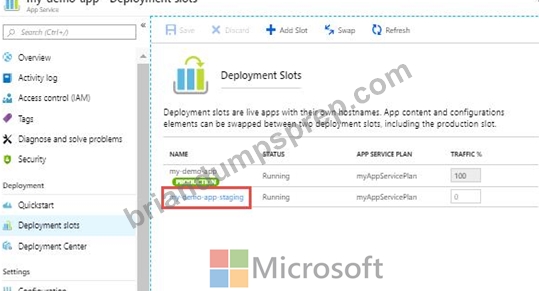
6. Change TRAFFIC % to 10 - B. Set up staging environments in Azure App Service
1. Open Microsoft Azure Portal
2. Log into your Azure account, select your app's resource page, in the left pane, select Deployment slots > Add Slot.
3. In the Add a slot dialog box, give the slot a name, and select whether to clone an app configuration from another deployment slot. Select Add to continue.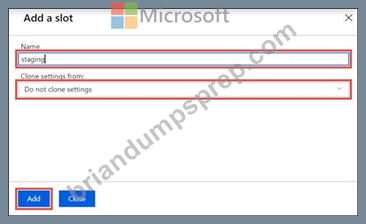
4. After the slot is added, select Close to close the dialog box. The new slot is now shown on the Deployment slots page. By default, Traffic % is set to 0 for the new slot, with all customer traffic routed to the production slot.
5. Select the new deployment slot to open that slot's resource page.
6. Change TRAFFIC % to 10
Answer: B
Explanation:
References:
https://docs.microsoft.com/en-us/azure/app-service/deploy-staging-slots
NEW QUESTION 91
Your company uses Team Foundation Server 2013 (TFS 2013).
You plan to migrate to Azure DevOps.
You need to recommend a migration strategy that meets the following requirements:
* Preserves the dates of Team Foundation Version Control changesets
* Preserves the changes dates of work items revisions
* Minimizes migration effort
* Migrates all TFS artifacts
What should you recommend? To answer, select the appropriate options in the answer area.
NOTE: Each correct selection is worth one point.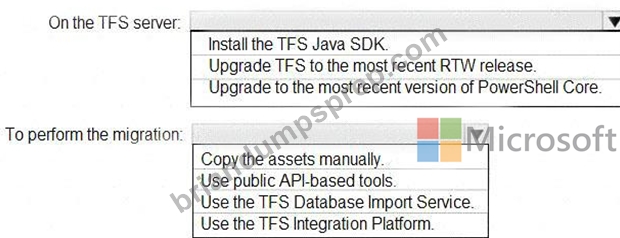
Answer:
Explanation: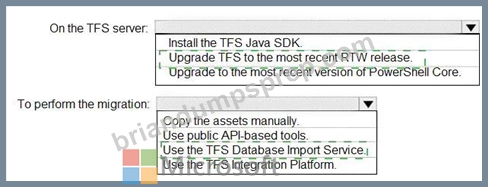
Explanation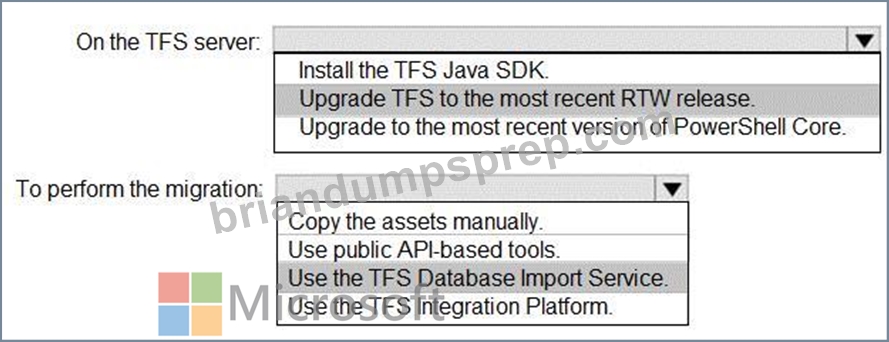
Box 1: Upgrade TFS to the most recent RTM release.
One of the major prerequisites for migrating your Team Foundation Server database is to get your database schema version as close as possible to what is currently deployed in Azure Devops Services.
Box 2: Use the TFS Database Import Service
In Phase 3 of your migration project, you will work on upgrading your Team Foundation Server to one of the supported versions for the Database Import Service in Azure Devops Services.
References: Team Foundation Server to Azure Devops Services Migration Guide
NEW QUESTION 92
You are developing an open source solution that uses a GitHub repository.
You create a new public project in Azure DevOps.
You plan to use Azure Pipelines for continuous build. The solution will use the GitHub Checks API.
Which authentication type should you use?
- A. a personal access token (PAT)
- B. GitHub App
- C. OpenID
- D. SAML
Answer: B
Explanation:
You can authenticate as a GitHub App.
Reference:
https://developer.github.com/apps/building-github-apps/authenticating-with-github-apps/
NEW QUESTION 93
Note: This question is part of a series of questions that present the same scenario. Each question in the series contains a unique solution that might meet the stated goals. Some question sets might have more than one correct solution, while others might not have a correct solution.
After you answer a question in this section, you will NOT be able to return to it. As a result, these questions will not appear in the review screen.
Your company has a project in Azure DevOps for a new web application.
You need to ensure that when code is checked in, a build runs automatically.
Solution: From the Triggers tab of the build pipeline, you select Enable continuous integration.
Does this meet the goal?
- A. Yes
- B. No
Answer: B
Explanation:
Explanation/Reference:
Explanation:
In Visual Designer you enable continuous integration (CI) by:
1. Select the Triggers tab.
2. Enable Continuous integration.
A continuous integration trigger on a build pipeline indicates that the system should automatically queue a new build whenever a code change is committed.
References:
https://docs.microsoft.com/en-us/azure/devops/pipelines/get-started-designer Testlet 1 Case Study This is a case study. Case studies are not timed separately. You can use as much exam time as you would like to complete each case. However, there may be additional case studies and sections on this exam. You must manage your time to ensure that you are able to complete all questions included on this exam in the time provided.
To answer the questions included in a case study, you will need to reference information that is provided in the case study. Case studies might contain exhibits and other resources that provide more information about the scenario that is described in the case study. Each question is independent of the other question on this case study.
At the end of this case study, a review screen will appear. This screen allows you to review your answers and to make changes before you move to the next section of the exam. After you begin a new section, you cannot return to this section.
To start the case study
To display the first question on this case study, click the Next button. Use the buttons in the left pane to explore the content of the case study before you answer the questions. Clicking these buttons displays information such as business requirements, existing environment, and problem statements. If the case study has an All Information tab, note that the information displayed is identical to the information displayed on the subsequent tabs. When you are ready to answer a question, click the Question button to return to the question.
Application Architecture
The company's primary application is a single monolithic retirement fund management system based on ASP.NET web forms that use logic written in VB.NET. Some new sections of the application are written in C#.
Variations of the application are created for individual customers. Currently, there are more than 80 live code branches in the application's code base.
The application was developed by using Microsoft Visual Studio. Source code is stored in Team Foundation Server (TFS) in the main office. The branch offices access the source code by using TFS proxy servers.
Architectural Issues
Litware focuses on writing new code for customers. No resources are provided to refactor or remove existing code. Changes to the code base take a long time, as dependencies are not obvious to individual developers.
Merge operations of the code often take months and involve many developers. Code merging frequently introduces bugs that are difficult to locate and resolve.
Customers report that ownership costs of the retirement fund management system increase continually.
The need to merge unrelated code makes even minor code changes expensive.
Customers report that bug reporting is overly complex.
Planned changes
Litware plans to develop a new suite of applications for investment planning. The investment planning applications will require only minor integration with the existing retirement fund management system.
The investment planning applications suite will include one multi-tier web application and two iOS mobile applications. One mobile application will be used by employees; the other will be used by customers.
Litware plans to move to a more agile development methodology. Shared code will be extracted into a series of packages.
Litware has started an internal cloud transformation process and plans to use cloud-based services whenever suitable.
Litware wants to become proactive in detecting failures, rather than always waiting for customer bug reports.
Technical requirements
The company's investment planning applications suite must meet the following requirements:
New incoming connections through the firewall must be minimized.
Members of a group named Developers must be able to install packages.
The principle of least privilege must be used for all permission assignments.
A branching strategy that supports developing new functionality in isolation must be used.
Members of a group named Team Leaders must be able to create new packages and edit the
permissions of package feeds.
Visual Studio App Center must be used to centralize the reporting of mobile application crashes and
device types in use.
By default, all releases must remain available for 30 days, except for production releases, which must
be kept for 60 days.
Code quality and release quality are critical. During release, deployments must not proceed between
stages if any active bugs are logged against the release.
The mobile applications must be able to call the share pricing service of the existing retirement fund
management system. Until the system is upgraded, the service will only support basic authentication over HTTPS.
The required operating system configuration for the test servers changes weekly. Azure Automation
State Configuration must be used to ensure that the operating system on each test server is configured the same way when the servers are created and checked periodically.
Current Technical Issue
The test servers are configured correctly when first deployed, but they experience configuration drift over time. Azure Automation State Configuration fails to correct the configurations.
Azure Automation State Configuration nodes are registered by using the following command.
NEW QUESTION 94
......
Free Exam Updates AZ-400 dumps with test Engine Practice: https://www.briandumpsprep.com/AZ-400-prep-exam-braindumps.html
Updated Verified AZ-400 dumps Q&As - 100% Pass Guaranteed: https://drive.google.com/open?id=13i6S_aBOMb5UiIbu5m-Et9vR0mKUvg3h
