

Pass Your CompTIA Exam with XK0-006 Exam Dumps (Updated 160 Questions)
XK0-006 Exam Dumps - CompTIA Practice Test Questions
CompTIA XK0-006 Exam Syllabus Topics:
| Topic | Details |
|---|---|
| Topic 1 |
|
| Topic 2 |
|
| Topic 3 |
|
| Topic 4 |
|
NEW QUESTION # 54
An administrator added a new disk to expand the current storage. Which of the following commands should the administrator run first to add the new disk to the LVM?
- A. pvresize
- B. vgextend
- C. lvextend
- D. pvcreate
Answer: D
Explanation:
Comprehensive and Detailed Explanation From Exact Extract:
To add a new physical disk to LVM, the disk must first be initialized as a physical volume using the pvcreate command. This prepares the new disk for use by the LVM subsystem. After initializing with pvcreate, you would use vgextend to add the new physical volume to an existing volume group.
Other options:
* A. vgextend adds a physical volume to a volume group, but you must use pvcreate first.
* B. lvextend is used to increase the size of a logical volume, not to add a new disk.
* D. pvresize is used to resize an existing physical volume, not to create one.
Reference:
CompTIA Linux+ Study Guide: Exam XK0-006, Sybex, Chapter 7: "Managing Storage", Section: "Managing Logical Volumes" CompTIA Linux+ XK0-006 Objectives, Domain 4.0: Storage and Filesystems
NEW QUESTION # 55
Which of the following is the location for built-in Linux executable files and utilities?
- A. /var
- B. /etc
- C. /bin
- D. /sys
Answer: C
Explanation:
/bin contains essential built-in Linux executable files and core command-line utilities required for basic system operation and user tasks.
NEW QUESTION # 56
An administrator updates the network configuration on a server but wants to ensure the change will not cause an outage if something goes wrong. Which of the following commands allows the administrator to accomplish this goal?
- A. netplan apply
- B. netplan try
- C. netplan rebind
- D. netplan ip
Answer: B
Explanation:
Network configuration changes can cause immediate loss of connectivity if applied incorrectly. Linux+ V8 emphasizes safe configuration practices, particularly when managing remote systems.
The netplan try command applies network configuration changes temporarily and prompts the administrator to confirm them within a timeout period. If the administrator does not confirm, Netplan automatically rolls back to the previous working configuration. This prevents accidental outages caused by misconfigured network settings.
The netplan apply command makes changes permanent immediately and does not provide rollback protection.
The other options are not valid Netplan commands.
Linux+ V8 documentation explicitly references netplan try as a safe testing mechanism. Therefore, the correct answer is A.
NEW QUESTION # 57
To perform a live migration, which of the following must match on both host servers? (Choose two)
- A. Available memory
- B. USB ports
- C. Disk storage path
- D. Network speed
- E. CPU architecture
- F. Available swap
Answer: A,E
Explanation:
Comprehensive and Detailed 250 to 350 words of Explanation From Linux+ V8 documents:
Live migration is a virtualization feature that allows a running virtual machine to be moved from one host to another with minimal or no downtime. This topic falls under System Management in the CompTIA Linux+ V8 objectives, particularly in the areas of virtualization and resource management.
For a live migration to succeed, the CPU architecture must match between the source and destination hosts.
This is critical because the running virtual machine's CPU state, instruction set, and registers must be compatible with the destination system. Migrating between different CPU architectures (for example, x86_64 to ARM) is not supported and would cause the virtual machine to fail. Therefore, option D is required.
Additionally, the destination host must have sufficient available memory to accommodate the virtual machine being migrated. During live migration, the memory contents of the running VM are copied from the source host to the destination host while the VM continues to run. If enough memory is not available, the migration cannot complete successfully. This makes option E mandatory.
The other options are not strict requirements. USB ports do not need to match for live migration. Network speed may affect migration performance but does not need to be identical. Available swap space is not directly required for migration. Disk storage paths do not need to match as long as shared storage or compatible storage access is available.
Linux+ V8 documentation emphasizes CPU compatibility and memory availability as core prerequisites for live migration. Therefore, the correct answers are D and E.
NEW QUESTION # 58
While reviewing local accounts on a server, a Linux administrator discovers that multiple users have not changed their passwords in more than a year. Which of the following commands should the administrator execute to bring the users' accounts into compliance with the 90-day guideline?
- A. usermod -aG 90
- B. passwd -d 90
- C. loginctl -H 90
- D. chage -M 90
Answer: D
Explanation:
The chage command is used to manage password aging policies, and setting the maximum password age to 90 days enforces the required password change interval for user accounts.
NEW QUESTION # 59
Which of the following commands should an administrator use to see a full hardware inventory of a Linux system?
- A. dmidecode
- B. dmesg
- C. lscpu
- D. lsmod
Answer: A
Explanation:
Hardware inventory and system information gathering are core responsibilities in Linux system management and are explicitly covered in CompTIA Linux+ V8 objectives. Among the listed commands, dmidecode is the most comprehensive tool for retrieving detailed hardware inventory information.
The dmidecode command reads data directly from the system's DMI (Desktop Management Interface) / SMBIOS tables, which are provided by the system firmware (BIOS or UEFI). It reports detailed information about system hardware components, including motherboard details, BIOS version, system manufacturer, CPU sockets, memory slots, installed RAM modules, serial numbers, and asset tags. This makes it the preferred tool when a full hardware inventory is required.
The other options provide only partial or specific information. lsmod lists currently loaded kernel modules and does not provide physical hardware inventory. dmesg displays kernel ring buffer messages, which may include hardware detection logs but are not structured or complete inventory data. lscpu reports CPU architecture and processor details only, not the entire system hardware.
Linux+ V8 documentation highlights dmidecode as the authoritative utility for system hardware discovery and inventory auditing. It is commonly used in enterprise environments for documentation, troubleshooting, capacity planning, and compliance reporting.
Because it provides the most complete and authoritative hardware information available from the system firmware, the correct answer is A. dmidecode.
NEW QUESTION # 60
A Linux systems administrator needs to extract the contents of a file named /home/dev/web.bkp to the /var
/www/html/ directory. Which of the following commands should the administrator use?
- A. unzip -c /home/dev/web.bkp /var/www/html/
- B. cd /var/www/html/ && gzip -c /home/dev/web.bkp | tar xf -
- C. pushd /var/www/html/ && cpio -idv < /home/dev/web.bkp && popd
- D. tar -c -f /home/dev/web.bkp /var/www/html/
Answer: C
Explanation:
Comprehensive and Detailed 250 to 350 words of Explanation From Linux+ V8 documents:
File extraction and backup restoration are fundamental System Management tasks covered in CompTIA Linux+ V8. In this scenario, the administrator must extract the contents of an existing backup file into a target directory.
The correct command is option B, which uses cpio in extract mode. The command changes into the destination directory (/var/www/html/) using pushd, extracts the archive contents with cpio -idv, and then returns to the original directory with popd. This ensures that files are restored into the correct location without modifying paths inside the archive.
The cpio utility is commonly used for backups created with cpio -o and supports reading archive data from standard input. Linux+ V8 documentation includes cpio as a valid and supported archive format for backup and restore operations.
The other options are incorrect. Option A incorrectly assumes the backup is a gzip-compressed tar archive.
Option C creates a new archive instead of extracting one. Option D assumes the file is a ZIP archive, which is not indicated by the .bkp extension.
Linux+ V8 emphasizes using the correct tool based on the archive format and restoring files into the intended directory. Therefore, the correct answer is B.
NEW QUESTION # 61
SIMULATION 4
Joe, a user, has taken a position previously held by Ann. As a systems administrator, you need to archive all the files from Ann's home directory and extract them into Joe's home directory.
INSTRUCTIONS
Within each tab, click on an object to form the appropriate commands. Command objects may only be used once, but the spacebar object may be used multiple times. Not all objects will be used.
If at any time you would like to bring back the initial state of the simulation, please click the Reset All button.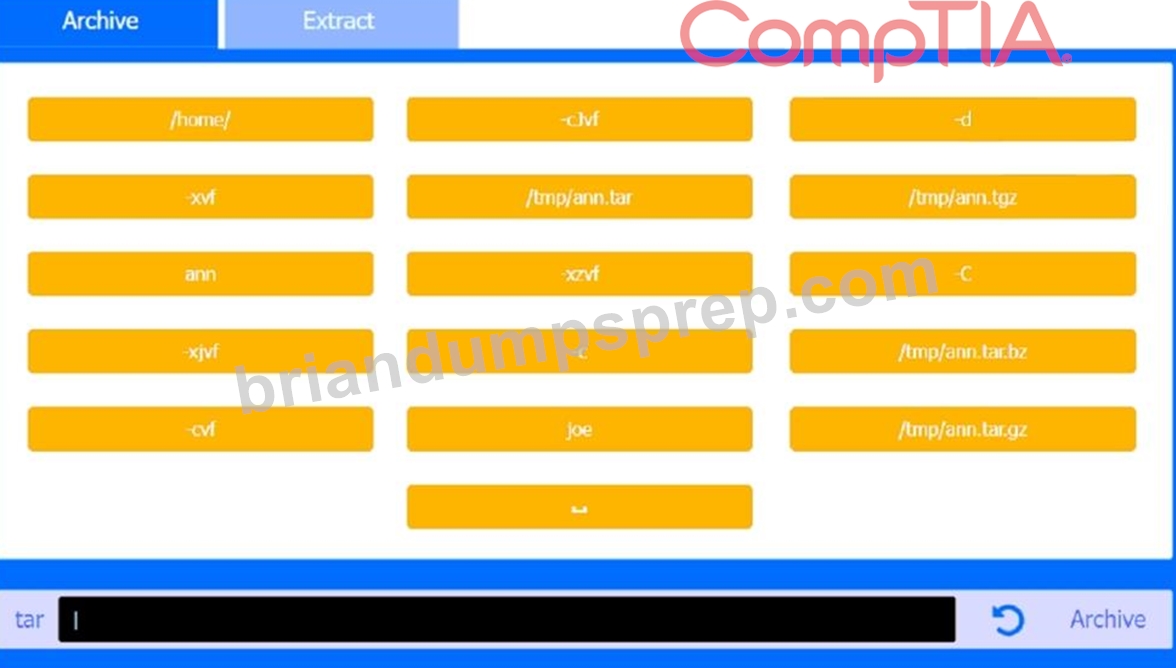
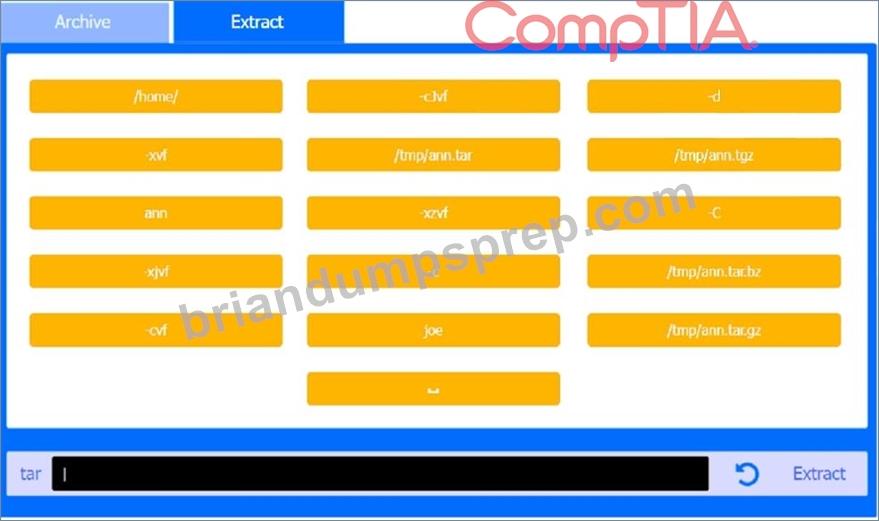
Answer:
Explanation:
Archive tab:
tar -cvf /tmp/ann.tar -C /home ann
Extract tab:
tar -xvf /tmp/ann.tar -C /home/joe
NEW QUESTION # 62
Which of the following Ansible components contains a list of hosts and host groups?
- A. Inventory
- B. Fact
- C. Collection
- D. Playbook
Answer: A
Explanation:
In Ansible, the inventory defines the list of managed nodes (hosts) and groups of hosts. It is the source from which Ansible knows what systems to configure or manage.
NEW QUESTION # 63
Which of the following commands should a Linux administrator use to determine the version of a kernel module?
- A. modprobe bluetooth
- B. modinfo bluetooth
- C. lsmod bluetooth
- D. depmod bluetooth
Answer: B
Explanation:
The modinfo command displays detailed information about a kernel module, including its version, author, description, and parameters.
NEW QUESTION # 64
Which of the following filesystems contains non-persistent or volatile data?
- A. /var
- B. /proc
- C. /usr
- D. /boot
Answer: B
Explanation:
The /proc filesystem is a virtual filesystem that provides process and kernel information. It is non- persistent and volatile, meaning its contents exist only in memory and are regenerated at each system boot.
NEW QUESTION # 65
Users cannot access a server after it has been restarted. At the server console, the administrator runs the following commands: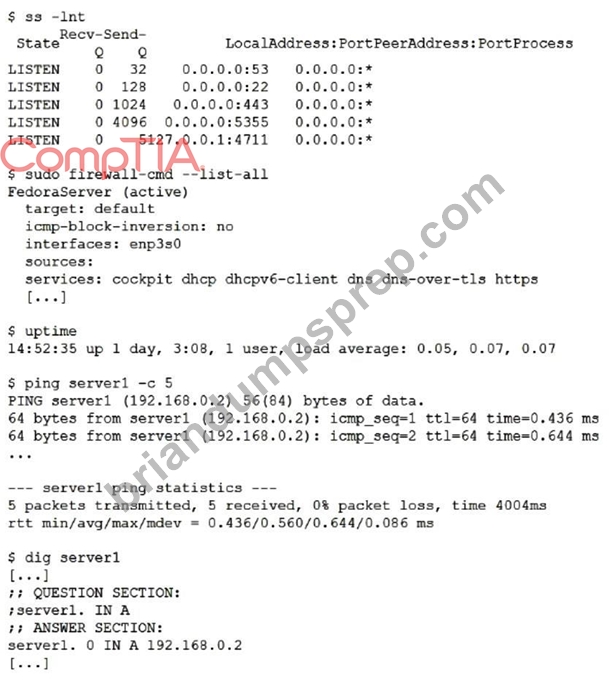
Which of the following is the cause of the issue?
- A. The wrong protocol is being used to connect to the web server.
- B. The SSH service has not been allowed on the firewall.
- C. The server load average is too high.
- D. The DNS entry does not have a valid IP address.
Answer: B
Explanation:
The server is running and responding to pings, and DNS resolves correctly (dig server1 →
192.168.0.2). The ss -lnt output shows SSH (port 22) is listening, but the firewall (firewall-cmd -- list-all) does not list SSH among the allowed services. Therefore, external users cannot connect because the firewall is blocking SSH.
NEW QUESTION # 66
An administrator receives reports that a web service is not responding. The administrator reviews the following outputs: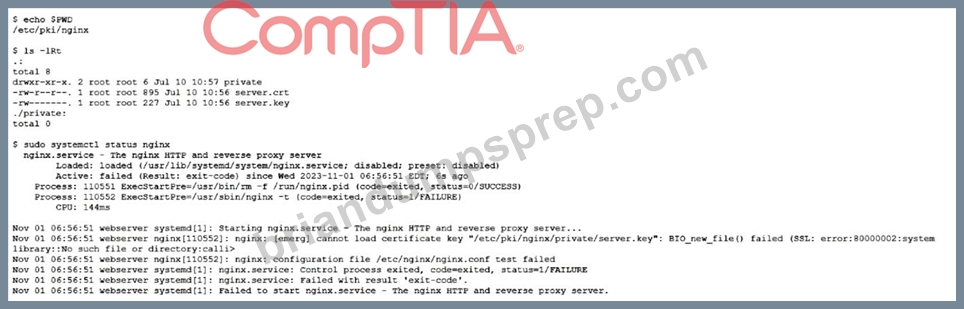
Which of the following is the reason the web service is not responding?
- A. The private key needs to be renamed from server.crtto server.keyso the service can find it.
- B. The private key does not match the public key, and both keys should be replaced.
- C. The private key is not in the correct location and needs to be moved to the correct directory.
- D. The private key has the incorrect permissions and should be changed to 0755for the service.
Answer: C
Explanation:
The error log shows "cannot load certificate key /etc/pki/nginx/private/server.key", but the listing reveals that server.key is located in /etc/pki/nginx/ rather than the expected /etc/pki/nginx/private/ directory. Since the file exists but not where Nginx is configured to look, moving it to the correct directory resolves the issue.
NEW QUESTION # 67
A Linux administrator tries to install Ansible in a Linux environment. One of the steps is to change the owner and the group of the directory /opt/Ansible and its contents. Which of the following commands will accomplish this task?
- A. usermod -aG Ansible /opt/Ansible
- B. chown -R Ansible:Ansible /opt/Ansible
- C. groupmod -g Ansible -n /opt/Ansible
- D. chmod -c /opt/Ansible
Answer: B
Explanation:
Comprehensive and Detailed Explanation From Exact Extract:
The chown command is used to change the owner and group of files and directories. The -R (recursive) flag ensures that all contents within the directory are also updated. The correct syntax is chown -R owner:group directory. So, chown -R Ansible:Ansible /opt/Ansible will change the owner and group for /opt/Ansible and everything inside it to "Ansible".
Other options:
* A. groupmod is used to modify group properties, not ownership of directories or files.
* C. usermod is for modifying user properties or group memberships.
* D. chmod changes permissions, not owner/group.
Reference:
CompTIA Linux+ Study Guide: Exam XK0-006, Sybex, Chapter 6: "User and Group Management", Section:
"Managing File Ownership and Permissions"
CompTIA Linux+ XK0-006 Objectives, Domain 1.0: System Management
NEW QUESTION # 68
A Linux administrator needs to add a new HTTP service on the server. Which of the following commands allows other systems to communicate with the service after the system is restarted?
- A. firewall-cmd --add-service=http --permanent
- B. firewall-cmd --add-service=http --reload
- C. firewall-cmd --add-service=http
- D. firewall-cmd --add-port=http --complete-reload
Answer: A
Explanation:
This command adds the HTTP service to the firewall's permanent configuration, ensuring the rule persists across system restarts and allows other systems to communicate with the service after reboot.
NEW QUESTION # 69
A Linux administrator attempts to unmount the local filesystem /datain order to mount a new volume. However, the administrator receives the following error message:
umount: /data: target is busy
Which of the following commands should the administrator run to resolve the issue?
- A. tree -g /data
- B. ls -ld /data
- C. stat -f /data
- D. fuser -mk /data
Answer: D
Explanation:
The fuser command identifies and terminates processes that are actively using the /data filesystem, allowing it to be safely unmounted once those processes are stopped.
NEW QUESTION # 70
User1 reports "access denied" errors while trying to execute app. Given the following outputs: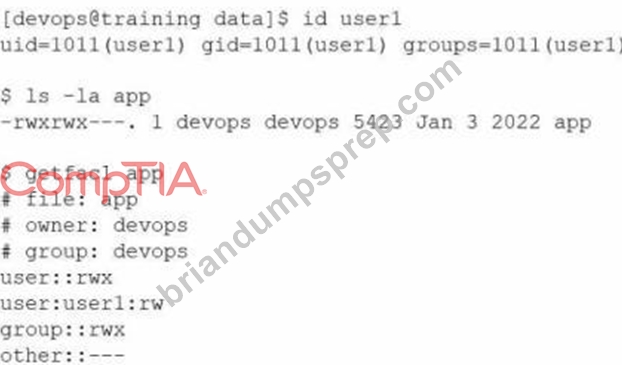
Which of the following options will remediate this issue?
- A. Providing execute permissions to user1 in the ACL
- B. Modifying the permissions for others to grant read, write, and execute
- C. Moving app to a different folder
- D. Adding user1 to the wheel group
Answer: A
Explanation:
According to the output of getfacl app, user1 has only "rw" (read and write) permissions, but lacks "x" (execute). Without execute permission, user1 cannot run the file. To allow user1 to execute app, you must update the ACL to add execute permission (e.g., setfacl -m u:user1:rwx app). Modifying "others" permissions (option B) is not secure or necessary, adding user1 to the wheel group (option C) is unrelated, and moving the file (option D) does not resolve permission issues.
Reference:
CompTIA Linux+ Study Guide: Exam XK0-006, Sybex, Chapter 7: "Securing Linux Systems", Section:
"Managing File and Directory Permissions and ACLs"
CompTIA Linux+ XK0-006 Objectives, Domain 3.0: Security
NEW QUESTION # 71
A systems administrator is configuring new Linux systems and needs to enable passwordless authentication between two of the servers. Which of the following commands should the administrator use?
- A. ssh-keyscan -t rsa && ssh-copy-id john@server2 -i ~/.ssh/key
- B. ssh-keygen -t rsa && ssh-copy-id -i ~/.ssh/id_rsa.pub john@server2
- C. ssh-agent -i rsa && ssh-copy-id ~/.ssh/key john@server2
- D. ssh-add -t rsa && scp -rp ~/.ssh john@server2
Answer: B
Explanation:
This command generates an SSH key pair and securely copies the public key to the remote server, enabling passwordless authentication by allowing key-based SSH login between the systems.
NEW QUESTION # 72
A Linux administrator prepares a backup script named testBack.sh. The backup script must be executed at 3:00 p.m. every Sunday. Which of the following crontabconfigurations will satisfy this requirement?
- A. 0 15 * * 0 testBack.sh
- B. 0 * * * 15 testBack.sh
- C. */15 * * * 0 testBack.sh
- D. * 15 * * 0 testBack.sh
Answer: A
Explanation:
This cron entry schedules the script to run at minute zero of hour fifteen every Sunday, which corresponds to 3:00 p.m. each week.
NEW QUESTION # 73
......
New Real XK0-006 Exam Dumps Questions: https://drive.google.com/open?id=1EC1BRwWysla1V4hz9J-IxDB81Qk66w_F
Pass Your XK0-006 Exam Easily with Accurate PDF Questions: https://www.briandumpsprep.com/XK0-006-prep-exam-braindumps.html
