

Get 100% Authentic Cisco 400-007 Dumps with Correct Answers
New Training Course 400-007 Tutorial Preparation Guide
NEW QUESTION # 50
Refer to the exhibit.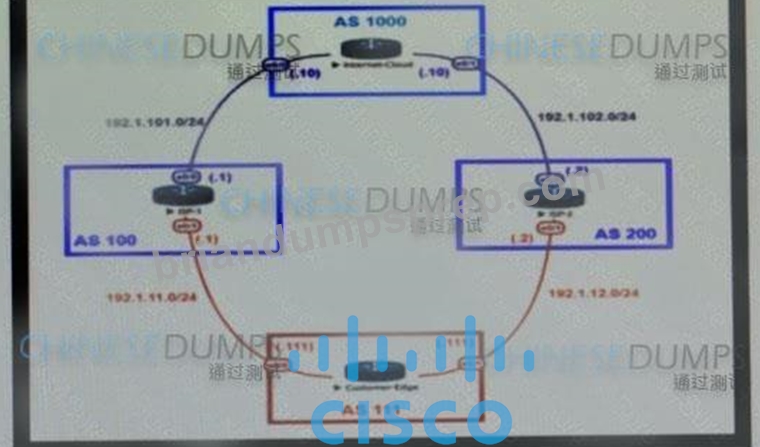
An engineer is designing the traffic flow for AS 111. Traffic from AS 111 should be preferred via AS 100 for all external routes. A method must be used that only affects AS 111. Which BGP attributes are best suited to control outbound traffic?
- A. local preference
- B. As path
- C. community
- D. MED
Answer: A
NEW QUESTION # 51
What are two parameters that can be leveraged by SAML in mixed private/public cloud environments by using identity and asset management? (Choose two.)
- A. policy-based tokens
- B. link federations
- C. unified directories
- D. multifactor hard tokens
- E. identity federations
Answer: A,E
Explanation:
In mixed private/public cloud environments, SAML (Security Assertion Markup Language) can leverage various parameters to enhance identity and asset management. Among the options provided, the two most pertinent parameters are:
Identity federation is a core concept in SAML, enabling users to access multiple systems across different organizations or domains using a single set of credentials. This is achieved through the establishment of trust relationships between identity providers (IdPs) and service providers (SPs), facilitating seamless single sign-on (SSO) experiences. In hybrid cloud environments, identity federation allows for centralized authentication, reducing the need for multiple credentials and enhancing security.
SAML utilizes tokens, known as assertions, which contain authentication and authorization information about users. These tokens can be policy-based, meaning they are issued and validated according to specific security policies and access controls defined by the organization.
Policy-based tokens ensure that access to resources is granted based on predefined rules, enhancing security and compliance in cloud environments.
By leveraging identity federations and policy-based tokens, organizations can effectively manage identities and assets across mixed cloud environments, ensuring secure and efficient access to resources.
NEW QUESTION # 52
A network security team observes phishing attacks on a user machine from a remote location. The organization has a policy of saving confidential data on two different systems using different types of authentication. What is the next step to control such events after the security team verifies all users in Zero Trust modeling?
- A. Enforce risk-based and adaptive access policies.
- B. Assess real-time security health of devices.
- C. Ensure trustworthiness of devices.
- D. Apply a context-based network access control policy for users.
Answer: C
NEW QUESTION # 53
Refer to the exhibit.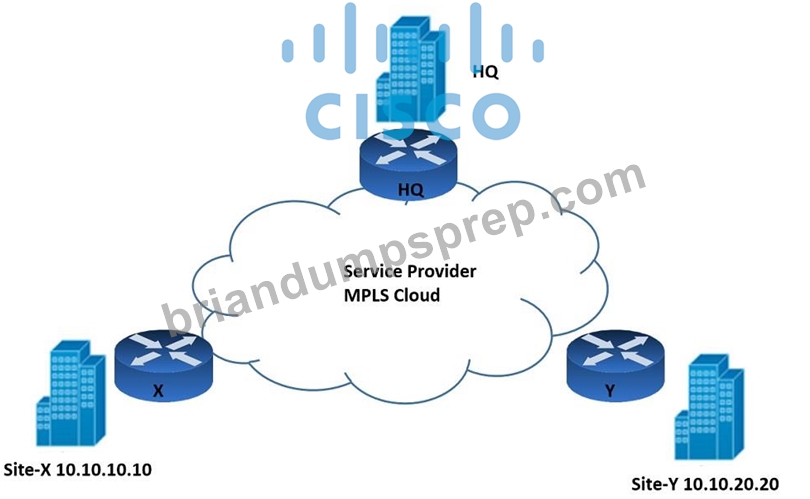
An architect must design an enterprise WAN that connects the headquarters with 22 branch offices. The number of remote sites is expected to triple in the next three years. The final solution must comply with these requirements:
* Only the loopback address of each of the enterprise CE X and Y routers must be advertised to the interconnecting service provider cloud network.
* The transport layer must carry the VPNv4 label and VPN payload over the MP-BGP control plane.
* The transport layer must not be under service provider control.
Which enterprise WAN transport virtualization technique meets the requirements?
- A. DMVPN per VRF
- B. MPLS over BGP over multipoint GRE
- C. EIGRP Over the Top
- D. point-to-point GRE per VRF
Answer: B
NEW QUESTION # 54
In the wake of a security compromise incident where the internal networks were breached by an outside attacker at the perimeter of the infrastructure, an enterprise is now evaluating potential measures that can help protect against the same type of incident in the future. What are two design options that can be employed? (Choose two)
- A. domain fencing
- B. virtualization
- C. microzoning
- D. segmentation
- E. microperimeters
Answer: D,E
NEW QUESTION # 55
Organizations need a solid foundation in governance practices to harness the potential of AI models to revolutionize the way they do business. This means providing access to AI tools and technology that is trustworthy, transparent, responsible, and secure. which benefits is primarily associated with integrating AI and ML in enterprise networks?
- A. Improve security and privacy through data governance
- B. enhanced scalability for handling data and models.
- C. Decreased need for model updates and monitoring.
- D. Dynamic risk assessments for cybersecurity.
Answer: D
Explanation:
Integrating AI/ML into enterprise networks is strongly associated with continuous, dynamic risk assessment for threats, anomalies, and vulnerabilities in real time.
NEW QUESTION # 56
A software-defined networking (SDN) controller learns network topology information by using BGP link- state sessions with the route reflectors of an MPLS-enabled network. The controller then uses the topology information to apply on-demand traffic policies to the network through a protocol that is supported from all Layer 3 routers. Each policy is represented as a RIB entry in the control plane of the router. Which SDN model has been implemented?
- A. SDN centralized
- B. SDN hybrid
- C. SD-WAN
- D. SDN traffic engineering
Answer: A
Explanation:
This scenario describes a centralized control mechanism where:
* The SDN controller learns the network topology using BGP Link-State (BGP-LS).
* The controller installs control-plane policies using protocols like PCEP or BGP.
* Policies are pushed centrally and result in new RIB entries at the routers.
This is the hallmark of a centralized SDN architecture:
* The controller has a global view and decision-making logic.
* Routers remain relatively simple in the control plane and act on instructions.
This aligns with CCDE v3.1 under the "Technology Comparisons and Use Cases" topic, where SDN models are compared:
* Centralized SDN (controller-driven)
* Distributed SDN (traditional)
* Hybrid (a blend of both, which is not represented here)
NEW QUESTION # 57
Retef to the exhibit.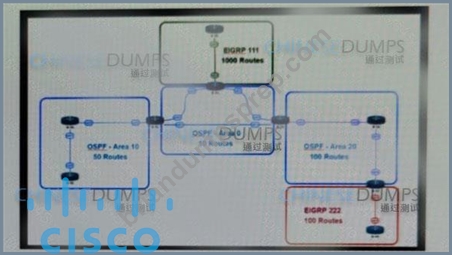
This network is running OSPF and EIGRP as the routing protocols Mutual redistribution of the routing protocols has been contoured on the appropriate ASBRs The OSPF network must be designed so that flapping routes m EIGRP domains do not affect the SPF runs within OSPF The design solution must not affect the way EIGRP routes are propagated into the EIGRP domains Which technique accomplishes the requirement?
- A. route summarization on EIDRP routers connecting toward the ASBR
- B. route summarization on the appropriate ASBRS.
- C. route summarization on the appropriate ABRS.
- D. route summarization the ASBR interfaces facing the OSPF domain
Answer: B
NEW QUESTION # 58
Company XYZ, a global content provider, owns data centers on different continents Their data center design involves a standard three-layer design with a Layer 3-only core VRRP is used as the FHRP They require VLAN extension across access switches in all data centers, and they plan to purchase a Layer 2 interconnection between two of their data centers in Europe in the absence of other business or technical constraints which termination point is optimal for the Layer 2 interconnection?
- A. at the access layer because the STP root bridge does not need to align with the VRRP active node
- B. at the aggregation layer because it is the Layer 2 to Layer 3 demarcation point
- C. at the core layer because all external connections must terminate there for security reasons
- D. at the core layer, to offer the possibility to isolate STP domains
Answer: B
NEW QUESTION # 59
Refer to the exhibit.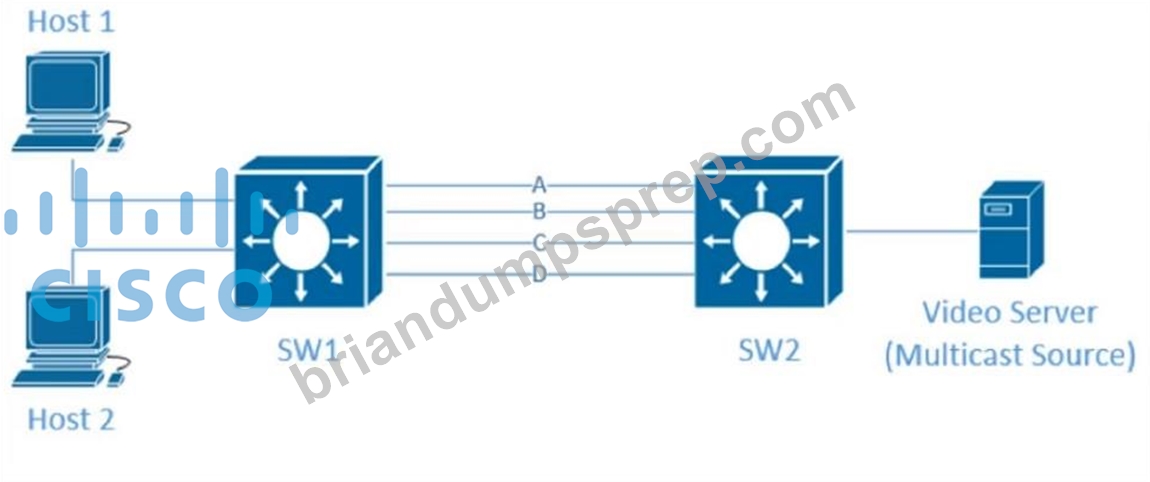
Traffic was equally balanced between Layer 3 links on core switches SW1 and SW2 before an introduction of the new video server in the network. This video server uses multicast to send video streams to hosts and now one of the links between core switches is over utilized Which design solution solves this issue?
- A. Filter IGMP joins on an over -utilized link.
- B. Add more links between core switches.
- C. Apply a more granular load- balancing method on SW1.
- D. Apply a more granular load-balancing method on SW2.
- E. Aggregate links Layer 2 link aggregation.
Answer: E
NEW QUESTION # 60
Company XYZ is running SNMPv1 in their network and understands that it has some flaws. They want to change the security design to implement SNMPv3 in the network Which network threat is SNMPv3 effective against?
- A. brute force dictionary attack
- B. man-in-the-middle attack
- C. masquerade threats
- D. DDoS attack
Answer: D
NEW QUESTION # 61
Which SDN architecture component is used by the application layer to communicate with the control plane layer to provide instructions about the resources required by applications?
- A. Southbound APIs
- B. Northbound APIs
- C. SDN controller
- D. Orchestration layer
Answer: B
Explanation:
* B (Northbound APIs):Northbound APIs allow applications to communicate with the SDN controller to express service requests and provide policy intent. The controller translates these into instructions for the underlying infrastructure.
Other options explained:
* A: Southbound APIs connect controllers to forwarding devices.
* C: Orchestration coordinates workflows across domains but doesn't directly connect applications to controllers.
* D: The SDN controller receives the northbound API calls but is not the API itself.
NEW QUESTION # 62
The General Bank of Greece plans to upgrade its legacy, end-of-life WAN network with a new flexible, manageable, and scalable solution. The main requirements are ZTP support, end-to-end encryption, application awareness, and segmentation. The CTO states that the main goal of the bank is CAPEX reduction. Which WAN technology should be used for the solution?
- A. SD-branch
- B. managed SD-WAN
- C. SD-WAN
- D. DMVPN with PfR
Answer: B
NEW QUESTION # 63
Which two benefits can software defined networks provide to businesses? (Choose two.)
- A. Reduced latency
- B. Reduction of OpEx/CapEx
- C. Provides additional redundancy
- D. Decentralized management
- E. Enables innovation
- F. Meets high traffic demands
Answer: B,E
Explanation:
* D (Enables innovation):SDN allows new services, business models, and automation capabilities.
* E (OpEx/CapEx reduction):Automation reduces operational effort, and commodity hardware reduces CapEx.
Other options explained:
* A: Redundancy depends on physical design.
* B: SDN centralizes management.
* C/F: SDN doesn't directly impact latency or capacity.
NEW QUESTION # 64
Refer to the exhibit.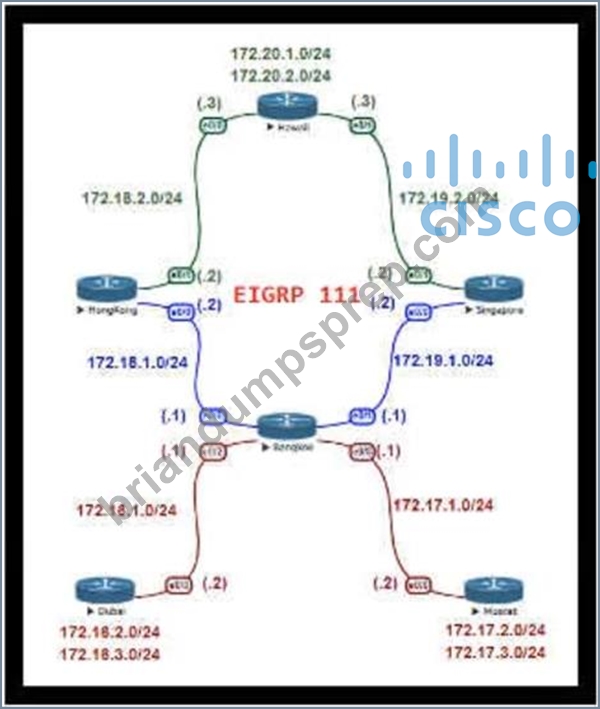
For Company XYZ Bangkok is using ECMP to reach the 172 20 2 0/24 network The company wants a design that would allow them to forward traffic from 172 16 2 0/24 toward 172 20 2 0/24 via the Singapore router as the preferred route The rest of the traffic should continue to use ECMP Which technology fulfills this design requirement?
- A. policy-based routing
- B. LFA
- C. unequal-cost load balancing using variance
- D. route summarization
Answer: A
NEW QUESTION # 65
Which parameter is the most important factor to consider when deciding service placement in a cloud solution?
- A. data replication cost
- B. security framework Implementation time
- C. data confidentiality rules
- D. application structure
Answer: C
NEW QUESTION # 66
You are tasked with the design of a high available network. Which two features provide fail closed environments? (Choose two.)
- A. L2MP
- B. EIGRP
- C. RPVST+
- D. MST
Answer: B,C
NEW QUESTION # 67
SDWAN networks capitalize the usage of broadband Internet links over traditional MPLS links to offer more cost benefits to enterprise customers. However, due to the insecure nature of the public Internet, it is mandatory to use encryption of traffic between any two SDWAN edge devices installed behind NAT gateways.
Which overlay method can provide optimal transport over unreliable underlay networks that are behind NAT gateways?
- A. IPsec
- B. GRE
- C. DTLS
- D. TLS
Answer: A
NEW QUESTION # 68
Drag and drop the optical technology design characteristics on the left to the correct optical technologies on the right. Not all options are used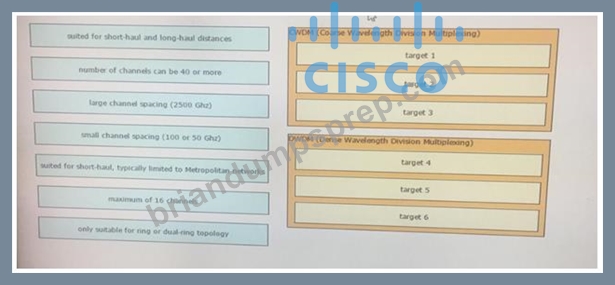
Answer:
Explanation: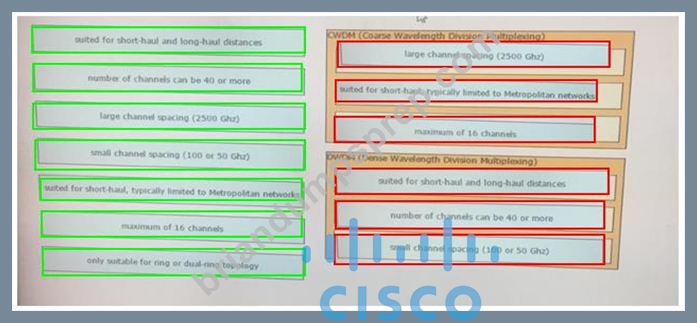
NEW QUESTION # 69
......
Dumps of 400-007 Cover all the requirements of the Real Exam: https://www.briandumpsprep.com/400-007-prep-exam-braindumps.html
Correct Practice Tests of 400-007 Dumps with Practice Exam: https://drive.google.com/open?id=1DkwjOBrYwu5qN6wR5JxR0yq617UClOrD
